
Timber decking and outdoor tiles are two different flooring systems that can be used for balconies, terraces, patios, gardens and other exterior spaces. The main differences in timber decking vs tiles relate to material composition, surface character, installation, drainage, heat exposure, maintenance and how each system responds to outdoor conditions.
Natural timber decking consists of solid wood boards installed over a supporting substructure. Outdoor tiles are hard-surface materials, commonly including porcelain or other products specifically designed for exterior flooring, installed using a suitable outdoor tiling system.
Malaysia's tropical climate makes the comparison particularly relevant. Frequent rainfall, high humidity and strong sunlight mean an outdoor surface needs to manage water effectively while remaining practical to clean and maintain.
The decision between wood decking vs tiles should therefore be based on the requirements of the specific outdoor area. Neither material is automatically suitable for every project, and appearance alone does not provide enough information to determine the better option for a particular space.
Timber Decking and Outdoor Tiles Compared
Timber decking and outdoor tiles create fundamentally different types of outdoor flooring. Timber forms a board-based surface over a substructure, while tiles normally create a hard, more continuous finished surface over an appropriately prepared base.
This difference affects drainage, surface feel, repair methods and construction.
A high-level comparison shows the main distinctions.
| Consideration | Timber Decking | Outdoor Tiles |
|---|---|---|
| Material | Natural wood | Manufactured ceramic, porcelain or other tile material |
| Surface character | Natural grain and board variation | Manufactured pattern and finish |
| Construction | Boards over a substructure | Tile system over prepared substrate |
| Surface joints | Gaps between boards | Grouted or system-specific joints |
| Water management | Water passes between boards | Water generally drains across the finished surface |
| Material movement | Timber responds to moisture | Tile system requires movement accommodation |
| Surface repair | Individual boards may be replaced | Individual tiles may sometimes be replaced |
| Weathering | Natural timber changes colour | Product-specific surface ageing |
| Maintenance | Cleaning, inspection and optional refinishing | Cleaning and joint/system maintenance |
These are general characteristics. Specific timber species and outdoor tile systems should still be evaluated individually.
What Is Timber Decking?
Timber decking is an outdoor surface made from natural wood boards supported by joists or another suitable substructure. The boards are installed with appropriate gaps to accommodate natural timber movement and allow rainwater to pass through the surface.
Timber is a natural material and does not remain visually unchanged outdoors.
Its colour and surface gradually respond to sunlight, rain and humidity. Depending on the species and maintenance approach, timber may darken, lighten or eventually develop a grey weathered appearance.
Suitable tropical hardwoods can be considered for Malaysian outdoor conditions when material quality, installation, drainage and maintenance are appropriate.
What Are Outdoor Tiles?
Outdoor tiles are hard flooring products designed or specified for exterior conditions. Porcelain and other suitable tile products may be used depending on the project and required performance.
Tiles normally rely on a prepared supporting substrate.
The complete installation can include waterproofing where required, adhesives or another approved fixing system, joints, movement provisions and appropriate surface drainage.
Not every tile designed for indoor use is automatically suitable outdoors.
The specific tile and installation system should be selected for the environmental exposure and intended use.
Appearance and Design Options
Timber and outdoor tiles provide distinctly different visual effects. Timber creates a natural board-based surface, while tiles can provide a wide range of manufactured colours, patterns, sizes and textures.
The preferred appearance depends on the architectural and landscape design.
Natural Timber Appearance
Timber provides genuine grain because every board comes from natural wood.
Colour and grain vary between boards even within the same timber species.
This variation can help timber integrate naturally with planting, stone, water features and other landscape elements.
The finished deck also develops visual character as the wood weathers.
Outdoor Tile Appearance
Outdoor tiles are manufactured and can provide relatively consistent colour and dimensions.
They may reproduce stone, concrete, wood-inspired or other visual styles depending on the product.
This can make tiles useful where a specific architectural finish or greater surface uniformity is desired.
The visual pattern remains manufactured rather than naturally occurring.
Natural Variation Versus Manufactured Consistency
Timber is naturally variable, while tiles generally offer greater manufactured consistency. This distinction can influence which material better matches the design expectations of a project.
A timber deck should not be expected to have identical boards.
Natural grain, colour variation and gradual weathering are inherent characteristics of wood.
Outdoor tiles can provide a more controlled repeating design.
However, variations can still occur between batches, and replacement tiles obtained later may not always match the original installation exactly.
Both materials therefore benefit from realistic expectations about long-term appearance.
Surface Feel and Outdoor Comfort
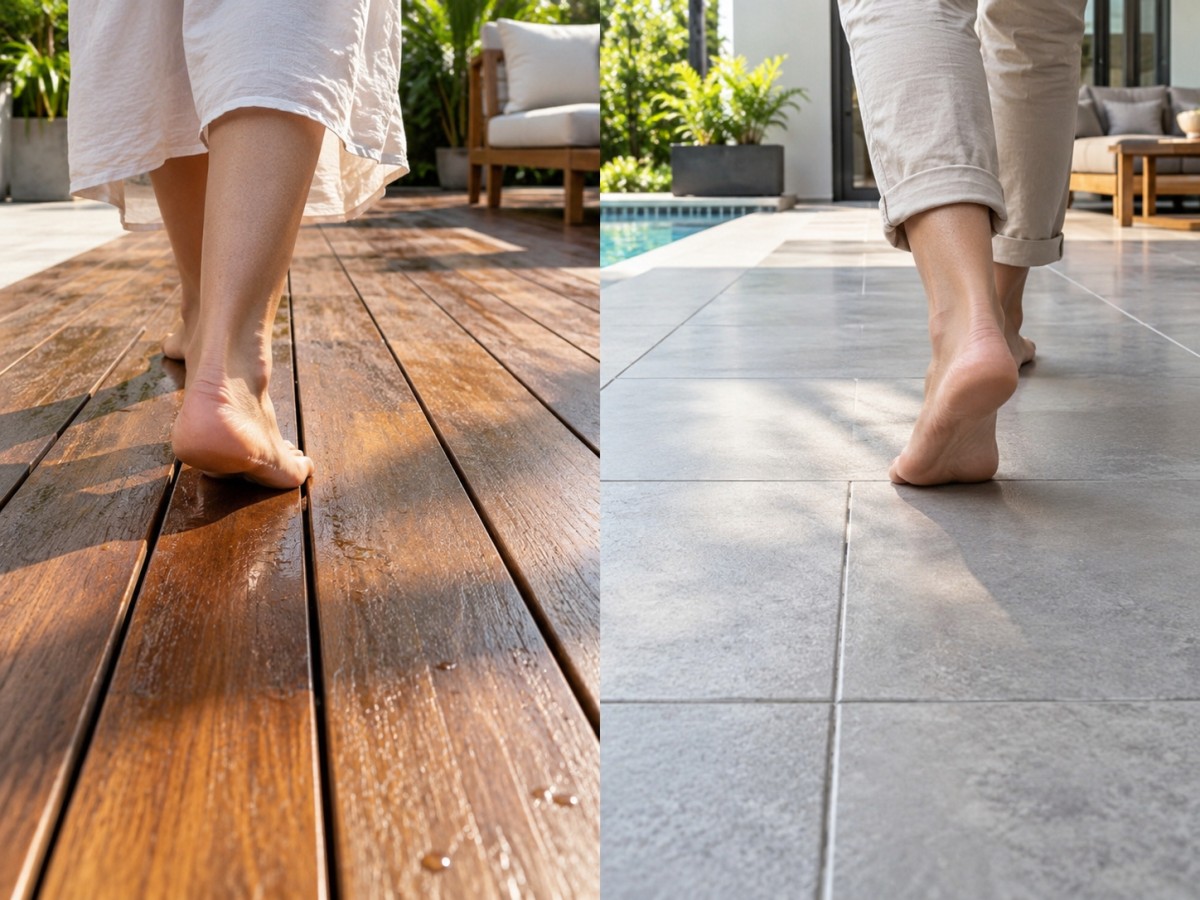
Surface feel depends on the material, texture, condition and environmental exposure. Timber and tile create noticeably different walking surfaces.
Natural timber provides a solid wood surface with grain and board joints.
Tiles create a harder mineral or ceramic-based surface whose texture depends on the selected product.
For areas where users may walk barefoot, such as pool surrounds or residential patios, surface condition and heat exposure deserve additional consideration.
How Heat Affects Timber Decking
Timber can become warm when exposed to direct Malaysian sunlight. Its surface temperature varies according to species, colour, density, duration of exposure and surrounding conditions.
Shade can significantly affect the experience of a timber deck.
A covered terrace can feel different from the same timber installed in an exposed area receiving strong afternoon sun.
No timber surface should be assumed to remain cool throughout the day when exposed directly to tropical sunlight.
How Heat Affects Outdoor Tiles
Outdoor tiles can also become hot under direct sunlight. Their surface temperature depends on colour, composition, finish and solar exposure.
Some dark tile surfaces may absorb substantial solar energy.
The thermal behaviour of a specific product should therefore be considered where barefoot use is expected.
This is particularly relevant around pools, open balconies and uncovered terraces.
Material samples should ideally be considered in relation to actual sunlight rather than evaluated only inside a showroom.
Timber Versus Tiles for Barefoot Areas
Barefoot comfort depends on more than whether the surface is timber or tile. Temperature, texture, cleanliness and wet conditions all influence how the surface feels.
Poolside applications require particular attention.
Timber boards should remain physically sound and free from problematic splintering or raised fasteners.
Outdoor tiles should have surface characteristics appropriate for wet conditions.
Both materials should also be maintained because algae, dirt and other contaminants can affect walking surfaces.
Drainage Is a Major Difference
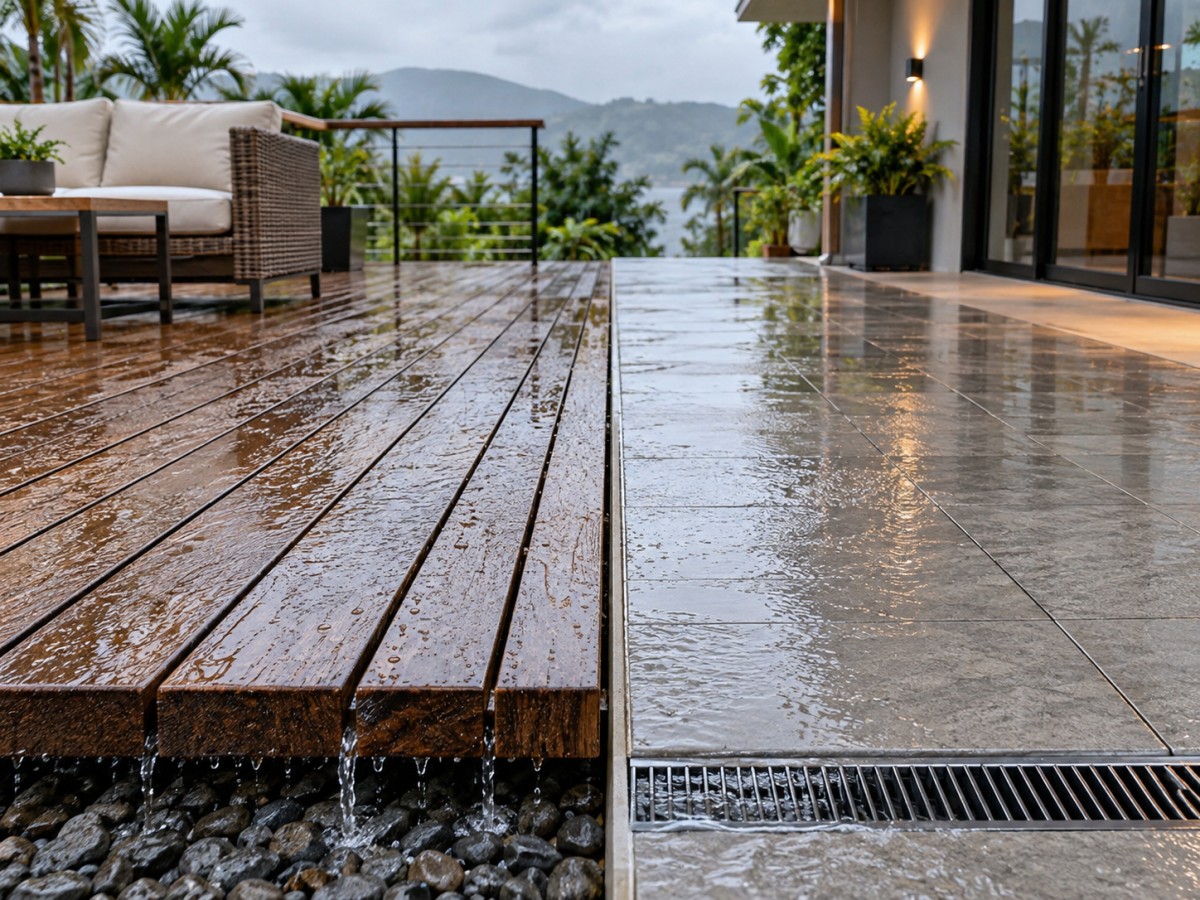
Drainage is one of the clearest differences between decking or tiles. Timber decking generally allows water to pass through gaps between boards, while tiled surfaces usually direct water across the finished floor towards drainage points.
Both approaches can work when correctly designed.
They simply manage water differently.
How Timber Decking Manages Rainwater
Timber decking uses board gaps as part of its surface drainage system. Rainwater passes between the boards and reaches the area beneath the deck.
The underlying surface must then direct that water towards appropriate drainage.
This means the deck itself does not eliminate the need for proper falls and outlets.
Board gaps should remain clear enough to allow water and debris management.
Drain access beneath the deck may also be required for maintenance.
How Outdoor Tiles Manage Rainwater
Outdoor tiled surfaces generally need appropriate falls so that water moves across the surface towards drainage points. The tile installation should work with the underlying waterproofing and drainage design where applicable.
Poor surface falls can allow water to remain on the tiled area.
The tile itself cannot correct an underlying drainage problem.
Joints, transitions and drainage interfaces should also be detailed appropriately for the outdoor environment.
The complete tiled system therefore matters as much as the visible tile.
Why Drainage Matters in Malaysia
Malaysia's frequent heavy rainfall means outdoor flooring should be designed around effective water management. This applies regardless of whether timber or tile is selected.
A balcony can receive substantial rain in a short period.
Garden terraces may also receive runoff from surrounding surfaces.
The selected flooring system should not block existing drains or create unnecessary water traps.
Drainage should therefore be assessed before the final surface material is chosen.
Water Beneath Timber Decking
Water beneath timber decking is normal when the system is designed to allow rain to pass through the board gaps. The important issue is whether that water can continue towards a suitable outlet and the area can dry.
Persistent standing water is different from temporary wetting.
Substructure components should not unnecessarily obstruct drainage.
Debris should also not be allowed to accumulate beneath accessible areas because it can retain moisture.
Where drains are located beneath the deck, suitable maintenance access should be considered.
Water on Outdoor Tiles
Water remains on top of a tiled surface until it moves towards the drainage system. Correct falls and suitable surface characteristics are therefore important.
Local low points can create puddles.
Outdoor tile selection should also account for wet use.
The relevant surface characteristics of the specific tile should be checked for the intended application rather than assuming all textured tiles behave identically when wet.
Installation Requirements for Timber Decking
Timber decking is installed as a board-and-substructure system. Site preparation, support, joist spacing, board gaps and fastening all contribute to the finished deck.
The construction method differs substantially from conventional tiling.
Substructure
The substructure supports the timber boards.
Joist spacing should suit the selected timber, board dimensions and intended use.
The supporting system should also work with existing site drainage.
Board Spacing
Timber boards need appropriate gaps.
These gaps accommodate moisture-related movement and allow water to pass through the surface.
Spacing requirements depend on the material and installation conditions.
Fasteners
Boards can be installed using suitable visible screws or compatible concealed fastening systems.
Dense hardwood may require pre-drilling.
Fastener selection should reflect outdoor exposure and the selected timber.
Installation Requirements for Outdoor Tiles
Outdoor tiles require a suitable substrate and an installation system appropriate for exterior exposure. The exact construction depends on the existing surface and project conditions.
Preparation is particularly important.
Substrate Condition
The underlying surface needs to provide a suitable base for the tile installation.
Movement, cracking or unsuitable conditions in the substrate can affect the finished surface.
Existing drainage falls should also be evaluated.
Waterproofing
Some outdoor areas require a waterproofing system beneath the finished tile surface.
The requirements depend on the building and location.
Decking or tiling work should not compromise existing waterproofing without appropriate assessment.
Tile Fixing and Joints
Outdoor tile installations require compatible fixing materials and appropriate joints.
Movement provisions may also be necessary depending on the area and system.
These components form part of the installation rather than being secondary details.
Installation Height and Existing Floor Levels
Available height can influence whether timber decking or tiles are practical. Door thresholds, drains and adjacent floor levels should be assessed before either system is installed.
Timber decking requires space for the boards and supporting structure.
Low-clearance systems can reduce the required height, but sufficient support and drainage still need to be maintained.
Tile systems also add thickness through the tile and installation layers.
The final finished floor level should not create drainage or threshold problems.
Maintenance and Cleaning
Both timber and outdoor tiles require cleaning, but their long-term maintenance differs. Timber is a natural material that may also receive appearance-focused surface treatment, while tile maintenance generally focuses on the surface and joints.
Neither material is maintenance-free.
Timber Cleaning
Timber should be kept clear of leaves, soil and other organic debris.
Board gaps should remain functional.
Cleaning methods should be suitable for the timber and any existing finish.
Overly aggressive treatment can unnecessarily affect the wood surface.
Tile Cleaning
Outdoor tiles require cleaning to remove dirt, environmental deposits and biological growth.
Textured surfaces can sometimes retain dirt differently from smoother finishes.
Joints may also require attention depending on the installation.
Cleaning methods should be compatible with the tile and joint materials.
Mould and Algae on Timber and Tiles
Mould and algae can affect both timber and tiled outdoor areas when moisture, shade and organic material create suitable conditions. Changing the surface material does not necessarily eliminate biological growth.
Shaded Malaysian outdoor areas can remain damp after rainfall.
Leaves, soil and environmental deposits can provide material on which growth develops.
Routine cleaning and effective drainage are therefore important for both systems.
Recurring problems should prompt inspection of shade, moisture and water flow rather than being treated only as a surface issue.
Weathering of Natural Timber
Timber visibly weathers outdoors. Sunlight changes its colour, while repeated wetting and drying can influence its surface over time.
This behaviour is natural.
Owners can choose to maintain a particular appearance using compatible surface treatments or allow the timber to age naturally.
Grey weathered timber is not automatically structurally damaged.
The physical condition of the boards should be assessed separately from colour.
Weathering of Outdoor Tiles
Outdoor tiles generally do not weather like natural timber, but they can still change in appearance because of dirt, staining, environmental deposits or product-specific ageing.
Joints can also influence how an older tiled surface looks.
The ease of maintaining a particular appearance depends on tile texture, colour and installation.
A very light or heavily textured outdoor tile may show certain forms of dirt differently from another product.
The actual application should therefore guide selection.
Durability and Outdoor Exposure
Durability for both materials depends on the quality of the product, suitability for the application and installation. Neither timber nor tile should be evaluated by material category alone.
A suitable hardwood deck can provide long-term outdoor service when moisture is properly managed.
An appropriate outdoor tile can also provide a durable hard surface when the substrate and installation system are correctly designed.
Failures in the supporting construction can affect either material.
This makes installation quality a central part of durability.
Timber Decking and Material Movement
Natural timber moves as its moisture content changes. This movement is expected and should be accommodated through appropriate board spacing and fastening.
Different timber species behave differently.
Board dimensions, grain and environmental exposure can also influence movement.
Problems are more likely when boards are installed without sufficient consideration for these natural changes.
The deck should therefore be designed as a timber system rather than treating the boards as rigid flooring panels.
Movement in Outdoor Tile Systems
Outdoor tile systems also need to account for movement, although the mechanism differs from timber. Temperature changes and movement in the substrate can place stress on tiled surfaces.
Appropriate joints and installation methods help manage these conditions.
A large tiled outdoor area should therefore not be treated as a completely static surface.
Product and system requirements should be followed for the specific installation.
Repairing Timber Decking
Timber decking is made from individual boards, so localised damage can sometimes be addressed by replacing specific boards. The practicality depends on the fastening system and condition of the substructure.
Replacement timber may initially look different from older boards.
Natural variation and previous weathering make perfect colour matching difficult.
If several boards show similar damage, the cause should be investigated before replacement.
A drainage or support problem may need to be corrected first.
Repairing Outdoor Tiles
Individual outdoor tiles can sometimes be replaced when localised damage occurs and compatible replacement material is available.
Removal needs to be carried out without unnecessarily damaging surrounding tiles or underlying systems.
Matching can become a challenge if the original tile is discontinued or a later production batch differs visually.
For this reason, future repairability should be considered when selecting highly distinctive tile products.
Timber Decking Around Drains and Services
Timber decking can sometimes provide access to drains or services beneath the surface through removable sections or planned access panels. This can be useful on balconies and terraces.
Access should be incorporated intentionally.
A loose or poorly supported board should not be used as an improvised maintenance hatch.
The opening should remain stable and practical for routine access.
Drain positions should therefore be identified before the deck layout is finalised.
Tiles Around Drains and Services
Tiled surfaces generally integrate drainage outlets directly into the finished floor. Drain levels and tile falls need to work together.
Future access to services beneath tiled surfaces can be more involved where components are not specifically designed to remain accessible.
This does not make tiles unsuitable.
It means service locations and drainage details should be understood before installation.
Planning these elements early reduces the likelihood of later disruption to the finished floor.
Timber Versus Tiles for Balconies
Both timber decking and outdoor tiles can be considered for balconies when the building conditions allow. The most suitable system depends on drainage, available floor height, maintenance preferences and design.
Timber creates a raised natural board surface.
Water generally passes between the boards to the existing balcony drainage below.
Tiles create a hard finished surface that normally directs water across the floor towards drains.
Condominium or building requirements should also be checked before changing balcony flooring.
Timber Versus Tiles for Patios and Terraces
Patios and terraces can use either timber or outdoor tiles depending on the intended appearance and construction. Both materials can define outdoor dining and seating areas.
Timber can create a warmer natural relationship with gardens and planting.
Tiles can create stronger visual continuity with architectural hardscape or interior tile finishes.
Exposure remains important.
An uncovered terrace may experience heavy rain and direct sun, while a covered patio may remain shaded and humid.
Timber Versus Tiles for Garden Areas
Garden flooring should respond to landscape conditions, soil, vegetation and drainage. Timber and tile create different relationships with these elements.
Natural timber can visually integrate with planting and other organic materials.
Outdoor tiles can create defined hardscape areas within a garden.
The supporting construction differs significantly.
Timber may be built as a supported deck, while tiled areas generally require an appropriate stable substrate.
The site conditions can therefore influence the practical choice.
Timber Versus Tiles for Poolside Areas
Poolside flooring needs to accommodate frequent water exposure, sunlight, cleaning and barefoot use. Both timber and appropriate outdoor tiles can be considered when their specific surface characteristics suit the application.
Suitable timber provides a natural board surface but requires attention to physical board condition and maintenance.
Outdoor tiles should be specifically appropriate for wet exterior use.
Heat also deserves consideration because exposed pool surrounds can receive intense sunlight.
The actual material should be evaluated rather than selecting solely by category.
Timber Versus Tiles for Commercial Spaces
Commercial outdoor flooring needs to reflect pedestrian traffic, cleaning frequency and operational requirements. Restaurants, hotels and resorts may use either timber or tiles depending on design and maintenance objectives.
Timber can support a natural hospitality aesthetic.
Tiles can provide a hard, manufactured finish suitable for a range of architectural styles.
The installation should also account for furniture movement, cleaning access and transitions between indoor and outdoor areas.
Project-specific safety and accessibility requirements should be addressed independently of aesthetic preference.
Replacement and Long-Term Considerations
Long-term planning should consider how each surface can be maintained, repaired and accessed. Timber and tile have different repair methods, but both can sometimes be addressed locally.
A practical comparison is useful.
| Long-Term Consideration | Timber Decking | Outdoor Tiles |
|---|---|---|
| Routine cleaning | Required | Required |
| Natural colour change | Expected | Not timber-style weathering |
| Surface refinishing | Possible for many timber decks | Generally not refinished like wood |
| Local replacement | Individual boards may be replaced | Individual tiles may be replaced |
| Matching replacement | Affected by timber variation/weathering | Affected by batch/product availability |
| Drain access | Can be incorporated beneath deck | Usually integrated into finished floor |
| Joint maintenance | Board gaps kept clear | Tile joints/system inspected |
| Moisture management | Above and below deck | Across surface and within installation system |
The long-term implications should be considered alongside the initial appearance.
Common Mistakes When Comparing Decking and Tiles
Material comparisons can become misleading when only colour or the visible surface is considered. Both systems depend on what is underneath them.
Comparing Indoor Tiles With Outdoor Timber
Not every tile is suitable for exterior use.
The comparison should involve a tile specifically appropriate for the intended outdoor environment.
Ignoring Drainage
Timber and tile manage rain differently, but both depend on functional drainage.
A new surface should not conceal or worsen an existing water problem.
Choosing Only by Surface Temperature
Heat is important, particularly for barefoot areas, but it is not the only requirement.
Drainage, maintenance, structural conditions and weather exposure also need consideration.
Assuming Timber Always Requires Excessive Maintenance
Timber requires cleaning and inspection, while appearance-focused refinishing depends on the desired finish.
Allowing timber to weather naturally changes the maintenance approach.
Assuming Tiles Need No Maintenance
Outdoor tiles still collect dirt and biological growth.
Joints, drains and textured surfaces also require cleaning and inspection.
How to Choose Between Timber Decking and Tiles
Choosing between timber and tiles requires evaluating the outdoor environment and deciding which type of surface better fits the project. The comparison should begin with site requirements rather than samples.
A practical selection process includes the following steps.
Identify the Intended Use
Determine whether the area will be used for seating, dining, circulation, pool access or another purpose.
Usage influences surface and maintenance priorities.
Assess Rain and Sun Exposure
Check how much direct rain and sunlight reaches the area.
Consider wind-driven rain even in covered spaces.
Review Existing Drainage
Identify floor drains, falls and water routes.
Determine whether a raised decking system or surface-drained tiled system fits these conditions.
Consider the Desired Appearance
Decide whether genuine natural wood or a manufactured hard surface better suits the design.
Consider how each material is expected to age.
Review Maintenance Expectations
Compare cleaning, weathering and repair requirements.
For timber, determine whether maintaining a particular colour is important.
Assess the Complete Installation
Review substructure, substrate, waterproofing where relevant, finished floor height and access requirements.
The surface should only be selected after these conditions are understood.
Frequently Asked Questions (FAQs)
Is timber decking better than outdoor tiles?
Neither material is universally better. Timber provides a natural board-based surface, while outdoor tiles create a hard manufactured finish. The suitable option depends on drainage, design, maintenance and site conditions.
Which is better for Malaysia's rainy climate?
Both suitable timber decking and appropriate outdoor tile systems can function in Malaysia. Timber needs effective drainage beneath the boards, while tiles need appropriate surface falls and drainage outlets.
Which surface gets hotter in the sun?
Both timber and tiles can become hot under direct sunlight. Surface temperature depends on material, colour, finish, exposure and shade rather than material category alone.
Is timber decking more comfortable underfoot?
Timber provides a different surface character from hard tiles, but comfort is influenced by temperature, surface condition and intended use. Barefoot areas should be assessed using the actual material proposed.
Which requires more maintenance?
Timber requires cleaning and inspection and may also be refinished if a particular appearance is desired. Tiles require cleaning and maintenance of joints, drains and the overall installation. The practical difference depends on the project.
Can timber decking be installed over existing tiles?
In some situations, a decking system may be installed over an existing surface if the substrate, height, drainage and support conditions are suitable. The existing tiled surface should be assessed rather than automatically assumed to be an appropriate base.
Can outdoor tiles look like timber?
Yes. Manufactured tiles can use wood-inspired colours and patterns. However, they remain tile surfaces and do not have the natural grain variation or material behaviour of solid timber.
Which is easier to repair?
Individual timber boards and individual tiles can sometimes be replaced. Ease of repair depends on the installation system, access and availability of matching replacement material.
Which is suitable for a poolside area?
Both suitable timber and outdoor tiles specifically appropriate for wet areas may be considered. Surface characteristics, drainage, heat, cleaning and barefoot use should guide the decision.
Should I choose decking or tiles for a balcony?
The decision depends on available installation height, existing drainage, building requirements, desired appearance and maintenance preference. Both can be suitable when the complete system works with the balcony conditions.
Choosing the Right Surface for the Way the Space Works
Timber decking and outdoor tiles can both create practical exterior flooring, but they manage the outdoor environment differently. Timber uses individual natural boards over a supporting structure, while tiles form a harder finished surface over an appropriate substrate.
The distinction affects more than appearance. Timber allows rainwater to pass between its boards, while tiles generally direct water across the surface. Timber naturally weathers and can often be refinished, while tiles maintain a manufactured surface that has different cleaning and repair requirements.
Malaysia's rainfall, humidity and sunlight make correct installation particularly important for both options. Drainage, supporting construction and maintenance should therefore be evaluated alongside the visible material.
The timber decking vs tiles decision is ultimately about matching the flooring system to the outdoor space. Understanding how each option handles water, heat, maintenance and long-term use provides a stronger basis for selection than choosing according to appearance alone.