
Outdoor decking materials in Malaysia need to perform under high humidity, frequent rainfall, strong sunlight and year-round tropical conditions. The main options include natural timber, hardwood decking and wood-plastic composite (WPC), with each material offering different characteristics in appearance, weather resistance, maintenance and long-term use.
Choosing between outdoor decking options should therefore go beyond selecting a colour or surface finish. The material needs to suit the location, level of weather exposure, expected foot traffic, maintenance preferences and supporting structure.
Natural timber provides genuine wood grain and develops its own weathered character over time. WPC combines wood-based fibres with polymers to create manufactured composite boards with more consistent dimensions and reduced routine surface maintenance. Within natural timber, individual hardwood species also vary significantly in density, durability and appearance.
This comparison explains the main types of decking materials available for Malaysian outdoor spaces, how they behave under tropical conditions and which factors should guide material selection. The focus is on material differences rather than installation procedures, detailed timber species rankings or maintenance schedules.
WHAT TO LOOK FOR IN OUTDOOR DECKING MATERIALS
A suitable outdoor decking material should match the environmental exposure, intended use and maintenance expectations of the space. No single decking material is automatically suitable for every outdoor application.
A sheltered condominium balcony, for example, experiences different conditions from an uncovered garden terrace. A poolside deck faces frequent surface moisture, while a restaurant terrace may experience heavier and more consistent foot traffic.
Several characteristics are useful when comparing materials.
Weather Resistance
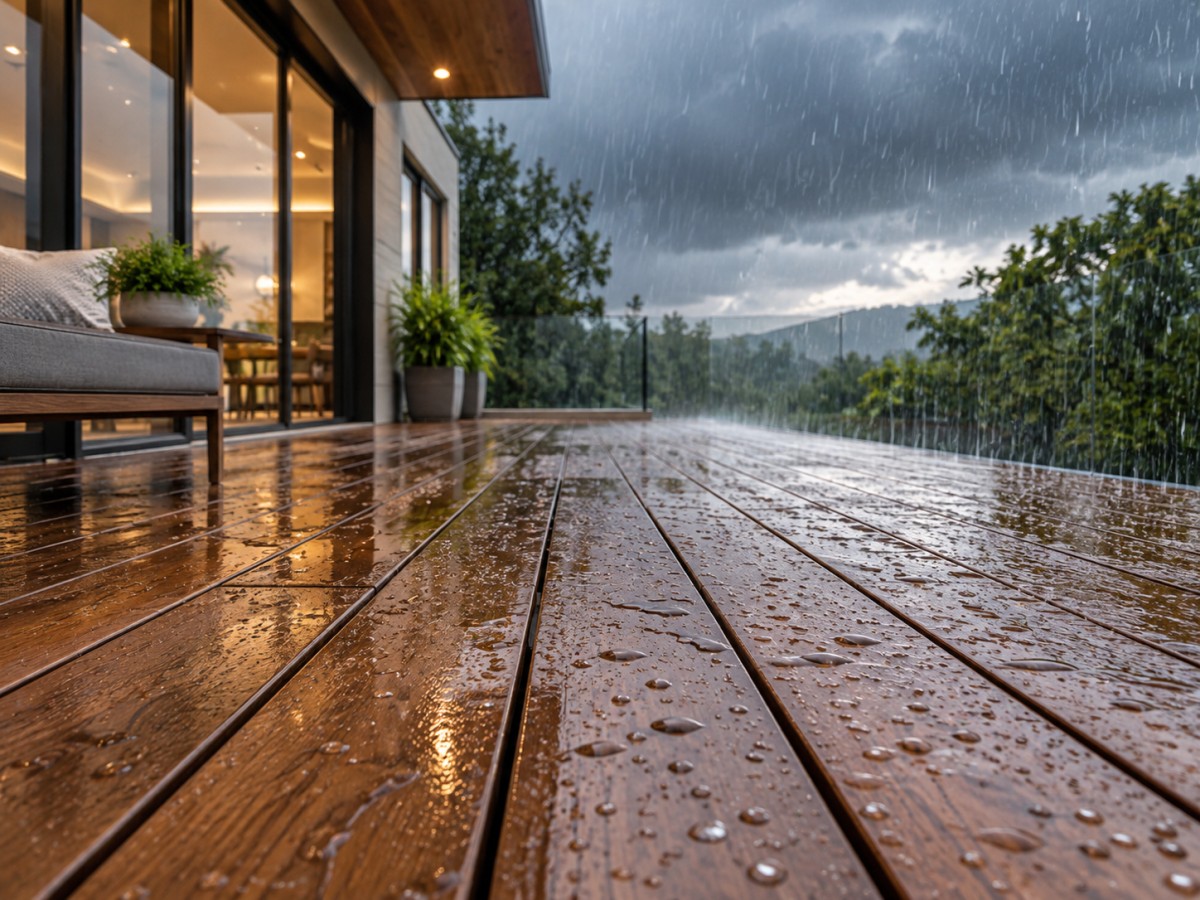
Weather resistance describes how a material responds to rain, humidity, sunlight and changing moisture conditions. This is particularly relevant in Malaysia because outdoor flooring can experience frequent wetting and relatively slow drying.
Natural wood responds to moisture by expanding and contracting. Composite products have different moisture and thermal behaviour depending on their formulation and construction.
Weather resistance should therefore be assessed according to the actual product rather than assuming that every board within a broad material category behaves identically.
Dimensional Stability
Dimensional stability refers to how much a material changes in size or shape when environmental conditions change. Natural timber and composite decking both experience movement, although the causes and patterns differ.
Timber primarily responds to moisture changes. Composite materials can also respond to temperature, which needs to be considered when determining board spacing and installation details.
Material stability is important because outdoor decks are assembled from multiple boards. The system needs sufficient allowance for expected movement without compromising drainage or surface consistency.
Surface Characteristics
The surface affects appearance, walking comfort and how easily dirt becomes visible. Natural wood provides genuine grain variation, while WPC boards can be manufactured with different textures and profiles.
Surface characteristics may also change over time. Timber weathers naturally, while composite surfaces can experience gradual changes in appearance depending on product formulation and exposure.
For areas that are regularly wet, surface characteristics should be evaluated with the intended application in mind.
Maintenance Requirements
All outdoor decking requires some level of cleaning and inspection. The main difference is the type and frequency of care required.
Natural timber may require surface treatment where maintaining a particular colour or finish is important. WPC generally does not require the same timber refinishing process, although it still needs cleaning and appropriate care.
"Low maintenance" should not be interpreted as "no maintenance". Leaves, dirt, moisture and environmental deposits can accumulate on any outdoor surface.
Appearance
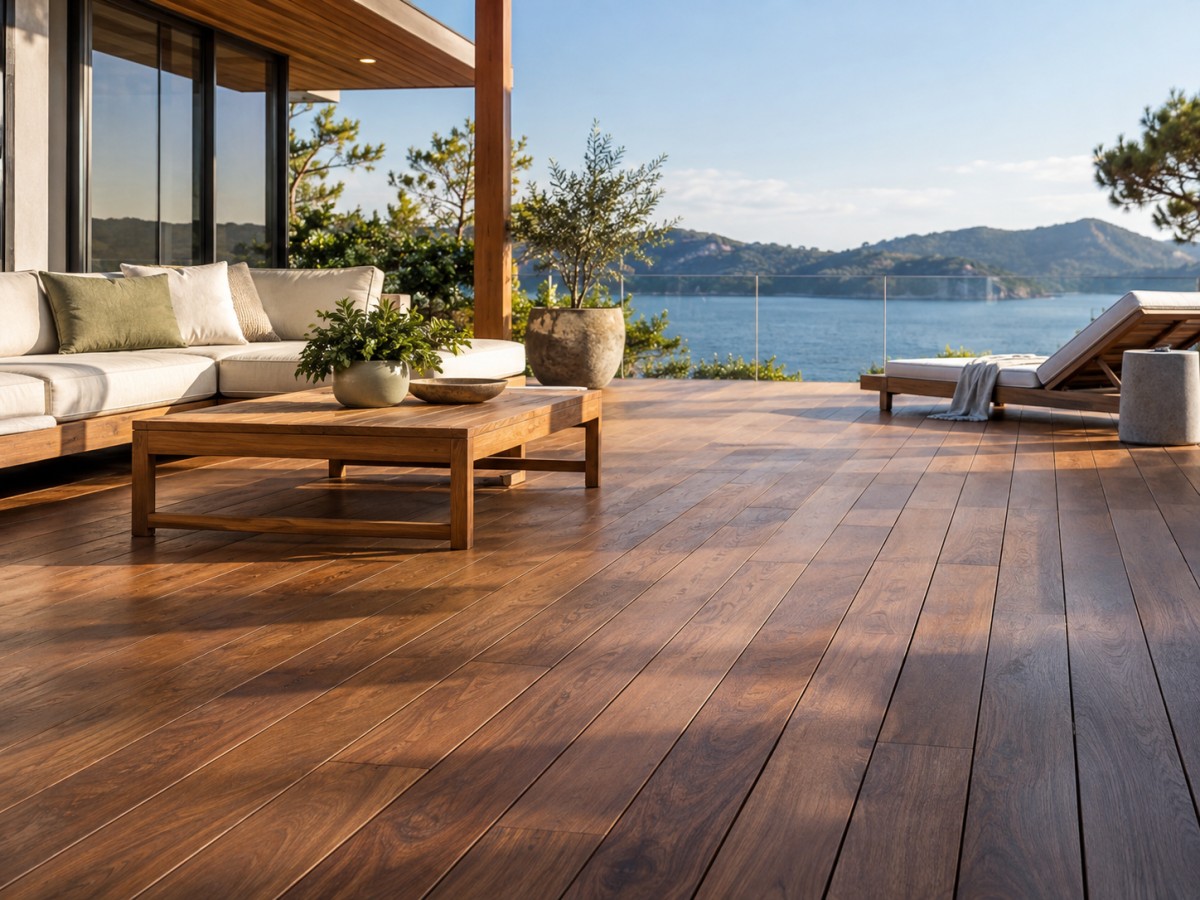
Appearance includes colour, grain, texture, board proportions and how the material changes after exposure. This is often one of the most visible differences between timber and composite decking.
Natural wood is inherently variable. WPC generally offers greater consistency between boards because its appearance is manufactured.
Neither characteristic is inherently better. The appropriate choice depends on whether the project prioritises natural variation or visual uniformity.
NATURAL TIMBER DECKING
Natural timber decking is made from solid wood boards selected and prepared for use as an outdoor flooring surface. It provides genuine wood grain, natural colour variation and material characteristics that cannot be exactly replicated by manufactured decking.
Timber remains relevant for Malaysian outdoor spaces because tropical hardwoods have a long history of use in exterior construction. However, performance varies significantly by species, timber quality, installation environment and maintenance.
Characteristics of Natural Timber
Natural timber is a biological material, so no two boards are completely identical. Variations in grain, colour and texture are normal. Its key characteristics include:
- ✓ Genuine grain and natural colour variation
- ✓ Moisture-related expansion and contraction
- ✓ Gradual weathering under outdoor exposure
- ✓ Ability to accept appropriate surface treatments
- ✓ Different performance characteristics between species
These characteristics mean timber should be evaluated as a natural material rather than expected to behave like a manufactured board.
How Timber Responds Outdoors
Outdoor timber absorbs and releases moisture according to surrounding conditions. Repeated wetting and drying can result in dimensional movement and gradual changes to the surface.
Sunlight also affects appearance. Timber exposed to UV radiation generally changes colour over time, while covered sections can weather at a different rate.
Correct material selection and construction allow for these natural processes instead of attempting to eliminate them.
HARDWOOD TIMBER OPTIONS
Hardwood decking uses timber from hardwood species selected for characteristics that can suit exterior environments. Tropical hardwoods such as Chengal, Merbau and Balau are among the materials associated with outdoor applications in Malaysia.
Hardwood is a broad classification rather than a single performance standard. Different species have different densities, durability characteristics, movement patterns and grain structures.
Dense Tropical Hardwoods
Dense tropical hardwoods are commonly considered for outdoor flooring because certain species have natural properties suited to demanding environments. Their density can provide a substantial surface but also affects cutting, drilling and fastening.
Examples encountered in outdoor decking include Chengal, Merbau, Balau, Belian and teak. Their specific characteristics should be assessed individually rather than assuming they are interchangeable.
Appearance of Hardwood Decking
Hardwood timber typically offers natural variation between individual boards. Colour can range from lighter brown tones to deeper red or dark brown shades depending on species and material.
Grain patterns also vary. Some woods appear relatively uniform, while others show more pronounced grain or colour contrast.
Outdoor exposure gradually changes these initial colours. Buyers should therefore consider both the appearance at installation and the expected weathered appearance.
Maintenance Considerations
Hardwood decking requires routine cleaning and inspection even when the timber has good natural durability. Surface treatments may also be used where maintaining a particular finish is desired.
The amount of care depends on exposure. Fully exposed decking generally experiences more direct weathering than a covered terrace or balcony.
WPC COMPOSITE DECKING
WPC composite decking is a manufactured decking material made by combining wood-based fibres or particles with polymers and other formulation components. The mixture is processed into boards designed for outdoor flooring applications.
WPC provides an alternative for projects where dimensional consistency, repeatable appearance and reduced timber-specific surface maintenance are important considerations.
The exact composition varies between manufacturers and product ranges. For this reason, performance should be evaluated using product-specific information rather than assuming all composite decking is identical.
How WPC Differs From Natural Timber
The main difference is material composition. Timber decking is natural solid wood, whereas WPC is an engineered composite.
This creates several practical distinctions. WPC generally has more consistent board dimensions and appearance, while natural timber provides genuine grain and organic variation.
WPC does not behave exactly like wood. Temperature-related movement, board profile and manufacturer-specific installation requirements need to be considered.
WPC Appearance
Composite boards can be produced in different colours, textures and surface patterns. Some products are designed to reproduce aspects of timber grain, while others have a more uniform contemporary appearance.
Manufacturing provides greater consistency between boards. This can be useful where a project requires a predictable overall colour or pattern.
The degree of timber-like appearance varies considerably between products. Samples should therefore be viewed where appearance is an important selection factor.
WPC Maintenance
WPC does not generally require the same refinishing approach as natural timber. Routine cleaning is still necessary to remove dirt, organic debris and environmental deposits.
Stains and spills should be addressed using methods appropriate to the specific composite product. Abrasive or unsuitable chemicals can affect some surfaces, so care guidance should be followed.
Reduced refinishing requirements are one reason WPC is considered for outdoor spaces where owners prefer a more straightforward maintenance routine.
TIMBER VS WPC COMPOSITE DECKING
Timber and WPC provide different material characteristics rather than one being universally superior to the other. The practical choice depends on which characteristics are most important for the specific project.
The main differences can be summarised as follows:
| Consideration | Natural Timber | WPC Composite |
|---|---|---|
| Composition | Solid natural wood | Wood-based material combined with polymers |
| Appearance | Genuine grain with natural variation | Manufactured, generally more consistent |
| Weathering | Natural colour changes with exposure | Product-specific appearance changes |
| Moisture response | Expands and contracts with moisture | Moisture behaviour depends on composition |
| Temperature response | Material movement occurs naturally | Thermal movement can be an important consideration |
| Surface care | Cleaning, inspection and possible refinishing | Cleaning and product-appropriate care |
| Board consistency | Natural variation | Generally more uniform |
| Finish options | Can accept suitable timber treatments | Factory-produced surface and colour |
| Material character | Natural and individually varied | Engineered and controlled |
The comparison should be used as a starting point. Product specifications, site conditions and installation requirements still need to be evaluated before selection.
MATERIAL PERFORMANCE IN MALAYSIA'S CLIMATE
Outdoor flooring in Malaysia must function under a combination of heat, humidity, rainfall and UV exposure. These conditions influence natural timber and WPC differently.
Material performance is therefore closely connected to the design of the entire decking system.
Performance During Heavy Rainfall
Frequent rainfall makes drainage important regardless of material. Water should be able to leave the deck surface and the space beneath it without being trapped.
Timber benefits from conditions that allow it to dry after rain. WPC also requires appropriate drainage because persistent moisture can encourage surface contamination and affect the surrounding structure even if the boards themselves respond differently from wood.
Selecting a weather-resistant material does not remove the need for drainage.
Performance Under High Humidity
Natural timber adjusts its moisture content in response to surrounding humidity. This contributes to expansion and contraction.
WPC does not respond to humidity in exactly the same way, but its formulation may still contain wood-derived material. Product-specific moisture behaviour should therefore be considered.
Both materials require appropriate board spacing and a supporting structure designed for outdoor conditions.
Performance Under Strong Sunlight
UV exposure can affect the appearance of outdoor flooring. Timber commonly develops natural colour changes, while composite materials may experience product-specific fading or surface changes.
Heat is another consideration. Outdoor surfaces exposed to direct tropical sun can become warm, with the extent depending on material, colour and environmental conditions.
This is particularly relevant for exposed balconies, rooftop spaces and pool surrounds where shade may be limited.
Wet and Shaded Locations
Shaded areas often dry more slowly after rain. Organic debris combined with moisture can encourage algae or surface growth on both timber and composite decking.
Material selection alone cannot eliminate this environmental condition. Cleaning access, airflow and drainage remain necessary.
OUTDOOR FLOORING FOR DIFFERENT TYPES OF SPACES
The most appropriate outdoor flooring material depends partly on where it will be installed. Different spaces create different levels of weather exposure, moisture and traffic.
Balcony Decking
Balconies often have restricted installation heights and existing drainage points. Decking materials should therefore be considered alongside thresholds, drain access and substructure requirements.
Natural timber can provide a warm, organic surface, while WPC may suit projects prioritising consistent board appearance and reduced refinishing.
The existing balcony construction remains a major factor regardless of surface material.
Patio and Terrace Decking
Patios and terraces may be covered, partially covered or fully exposed. This variation affects how quickly materials weather.
A sheltered terrace may experience less direct rainfall but still remain exposed to humidity. Fully open terraces require greater consideration of UV, rain and drainage.
Both timber and WPC can be considered where the chosen system suits the site's conditions.
Garden Decking
Garden decks interact directly with landscaping, soil, vegetation and organic debris. Moisture management and ventilation are therefore particularly important.
Natural timber can visually complement planted areas, while composite boards can provide a more uniform surface. The decision should also account for cleaning access around plants and landscaped edges.
Poolside Decking
Pool surrounds experience regular surface water in addition to rainfall. Drainage and surface characteristics become especially important.
Material suitability should be assessed for the specific pool environment rather than relying only on a general outdoor-use description. The deck should also be easy to inspect and clean.
Commercial Decking
Commercial spaces can experience higher pedestrian traffic and more frequent cleaning than residential decks. Restaurants, hotels, retail areas and other facilities may therefore prioritise predictable surface characteristics and maintenance procedures.
Material selection should account for operational requirements, expected loading and applicable project specifications.
WEATHER RESISTANCE IS MORE THAN MATERIAL CHOICE
Weather resistance depends on the interaction between the decking material, supporting structure, installation details and surrounding environment. Choosing an outdoor-rated board cannot compensate for poor water management or unsuitable construction.
Three areas are especially important.
Drainage
Water needs a clear route away from the deck. Existing drains should remain functional and accessible where maintenance is required.
Blocked drainage can create persistent moisture regardless of whether the surface is timber or composite.
Ventilation
Air movement beneath the decking can support drying. The amount of ventilation available depends on the installation design and deck height.
Enclosed spaces need particular attention because restricted airflow can allow moisture to remain beneath the boards.
Board Spacing
Spacing accommodates movement and allows water to pass through the deck surface. The required gap depends on the material and installation system.
Natural timber and WPC should not automatically be installed using identical spacing rules. Product or material-specific requirements need to be followed.
MAINTENANCE AND LONG-TERM CARE
Maintenance should be considered when comparing types of decking materials because different materials require different forms of care. No exterior flooring surface remains unchanged indefinitely.
Caring for Natural Timber
Natural timber generally requires cleaning, inspection and management of its surface condition. Owners who want to preserve a particular colour or finish may also choose periodic treatment.
Leaves and dirt should not be allowed to accumulate for extended periods because they can retain moisture.
Maintenance should also include checking accessible boards and fixings for changes that require attention.
Caring for WPC
WPC generally requires routine washing or cleaning rather than timber-style refinishing. The exact method depends on the manufacturer's recommendations and the type of contamination.
Spills should be addressed appropriately, particularly where food, oil or other staining substances are present.
The absence of timber refinishing does not eliminate the need to keep the deck and drainage system clean.
APPEARANCE AND DESIGN CONSIDERATIONS
Appearance is determined by more than colour. Board width, surface texture, grain pattern, laying direction and interaction with the surrounding architecture all influence how outdoor decking looks.
Natural timber and WPC provide different design characteristics.
Natural Variation
Timber contains natural grain and colour differences. These variations can create a less uniform appearance across the deck.
The surface also evolves as it weathers. Owners selecting timber should therefore be comfortable with natural variation rather than expecting every board to remain identical.
Manufactured Consistency
WPC generally provides greater consistency in colour, profile and texture. This can suit projects where a controlled visual pattern is preferred.
Some product ranges provide several board colours or textures, allowing the decking to coordinate with building finishes and landscaping.
Board Direction
Board orientation influences visual proportions. Boards can be arranged to emphasise the length or width of an outdoor area, subject to the requirements of the supporting structure.
Complex patterns can increase installation requirements. A layout should therefore balance visual goals with practical construction.
COMPARING DURABILITY
Decking durability is the ability of the complete system to remain serviceable under expected environmental and usage conditions. It should not be assessed using the surface material alone.
Natural timber durability depends partly on species and timber quality. Dense tropical hardwoods can have strong natural durability characteristics, but moisture management and installation remain important.
WPC durability depends on formulation, board construction, manufacturing quality and correct installation. Because WPC is a category containing different products, broad claims about all composite decking should be treated cautiously.
For either material, the following factors influence long-term performance:
- ✓ Quality and suitability of the selected boards
- ✓ Supporting structure and installation
- ✓ Drainage and ventilation
- ✓ Sun and moisture exposure
- ✓ Foot traffic and intended use
- ✓ Routine cleaning and inspection
A durable surface installed over an unsuitable substructure can still develop problems. Decking should therefore be evaluated as a system.
COMPARING OUTDOOR DECKING BY PRACTICAL PRIORITIES
Different materials become more or less suitable depending on what the project prioritises. A practical comparison should start with those priorities rather than searching for one universally "best" material.
| Project Priority | Material Characteristics to Consider |
|---|---|
| Genuine natural grain | Natural timber |
| Consistent board appearance | WPC composite |
| Natural weathering | Timber |
| Reduced need for surface refinishing | WPC composite |
| Ability to refresh a timber finish | Natural timber |
| Predictable manufactured profile | WPC composite |
| Tropical hardwood character | Hardwood timber |
| Multiple manufactured colours or textures | WPC composite |
These are general characteristics rather than guarantees of performance. Individual timber species and WPC products can differ substantially.
HOW TO CHOOSE THE RIGHT OUTDOOR DECKING MATERIAL
Choosing the right material starts by defining the conditions the decking must handle. Material selection becomes easier once environmental exposure, use and maintenance expectations are clear.
COMMON MISTAKES WHEN COMPARING DECKING MATERIALS
Decking comparisons can become misleading when broad assumptions are applied to entire material categories. A more accurate comparison recognises that individual products, species and site conditions vary.
Assuming All Hardwood Is the Same
Hardwood is a broad botanical and commercial category. Different hardwood species can have substantially different physical and durability characteristics.
The actual species should be identified whenever possible.
Assuming All WPC Is the Same
WPC products differ in composition, profile, manufacturing process and surface design. One composite product cannot represent the performance of every WPC board.
Product-specific specifications are therefore important.
Comparing Only Initial Appearance
A deck changes after installation. Timber weathers naturally, while composite products may also experience appearance changes under environmental exposure.
Selection should consider expected long-term appearance rather than only a new sample.
Ignoring the Substructure
The surface material receives most of the attention because it is visible, but the supporting system is equally important.
Poor support, drainage or ventilation can affect an otherwise suitable decking material.
Treating Low Maintenance as No Maintenance
Every outdoor deck is exposed to dirt, moisture and environmental deposits. Cleaning and inspection remain necessary even when a material does not require refinishing.
Maintenance expectations should be realistic before selection.
FREQUENTLY ASKED QUESTIONS (FAQS)
What are the main outdoor decking materials used in Malaysia?
Natural timber, hardwood timber and WPC composite are among the main outdoor decking options used for Malaysian properties. Individual products within these categories vary, so the specific material should be assessed according to site conditions and intended use.
Is timber or WPC better for outdoor decking?
Neither material is universally better for every application. Timber provides genuine natural grain and can be maintained or refinished, while WPC provides a manufactured surface with greater consistency and generally less need for timber-specific refinishing. Site conditions and owner priorities should determine the choice.
Which decking material requires less maintenance?
WPC generally requires less surface refinishing than natural timber, although it still needs routine cleaning and inspection. Timber maintenance varies according to species, exposure and whether the owner wants to preserve a particular surface finish.
Can natural timber handle Malaysia's rainy climate?
Suitable timber can be used outdoors in Malaysia when the complete decking system provides appropriate drainage, ventilation and spacing. Timber species and material quality also affect suitability. Persistent trapped moisture should be avoided regardless of the wood selected.
Does composite decking look like real wood?
Some WPC products use textures and patterns intended to resemble natural wood, but they remain manufactured materials. Natural timber has inherent grain and board-to-board variation that cannot be exactly reproduced.
Do decking materials become hot in direct sunlight?
Outdoor surfaces can become warm when exposed to strong sunlight. Surface temperature depends on factors including material, colour, exposure and surrounding conditions. This should be considered for uncovered areas and spaces where users may walk barefoot.
Can the same decking material be used for balconies and gardens?
A material may be suitable for both, but the installation requirements can differ considerably. Balconies often have limited height and existing drainage systems, while garden decks may interact with soil, vegetation and ground moisture.
Does WPC need gaps between the boards?
Yes. Composite decking systems normally require appropriate spacing for drainage and material movement. The exact requirements depend on the product and installation specifications.
Is hardwood always more durable than composite decking?
No universal comparison can be made from the category names alone. Hardwood durability varies by species and condition, while composite durability varies by formulation and manufacturing quality. Installation and environmental exposure also influence both.
MAKING A MATERIAL CHOICE THAT FITS THE OUTDOOR SPACE
Outdoor decking materials should be selected according to the conditions of the property rather than a single characteristic such as appearance or maintenance. Natural timber, hardwood and WPC each respond differently to Malaysia's rain, humidity, sunlight and outdoor use.
Timber is relevant where genuine wood grain, natural variation and the ability to maintain a timber finish are priorities. WPC is an alternative where manufactured consistency and reduced timber-specific refinishing are preferred. Within both categories, actual material specifications remain important.
The supporting system should also be considered from the beginning. Drainage, ventilation, board spacing and installation details affect long-term performance regardless of the surface selected.
A useful material comparison therefore considers the complete environment in which the deck will operate. Matching the decking to its application, exposure and maintenance expectations provides a stronger basis for selection than treating one material as suitable for every outdoor space.