
WPC decking requires regular cleaning and inspection even though it generally needs less appearance-focused maintenance than natural timber. Effective WPC decking maintenance in Malaysia should focus on removing dirt and stains, managing mould and algae, keeping drainage clear and checking the decking system for changes caused by outdoor exposure.
WPC, or Wood Plastic Composite, is manufactured using wood-derived material combined with polymer and other formulation components. Its composition gives it different maintenance requirements from solid timber, but it does not make the surface maintenance-free.
Malaysia's frequent rainfall, high humidity, strong sunlight and warm temperatures can influence how quickly dirt accumulates, how long surfaces remain damp and how biological growth develops. Shaded balconies, gardens and poolside areas can have particularly different maintenance needs from fully exposed decks.
A practical composite decking maintenance programme should therefore respond to the actual environment. Routine cleaning, prompt attention to spills, effective drainage and periodic inspection can help maintain the appearance and function of the complete WPC decking system.
Why WPC Decking Still Needs Maintenance
WPC decking still needs maintenance because every outdoor surface collects dust, soil, leaves, organic material and other environmental deposits. Moisture and shade can then create conditions where mould or algae develops on accumulated surface material.
The composite board itself is only one part of the deck.
Fasteners, clips, substructure, board gaps and drainage routes also require attention.
Regular maintenance helps identify problems such as blocked drainage or loose components before they affect a larger section of the decking system.
WPC should therefore be described as relatively low-maintenance rather than maintenance-free.
WPC Maintenance Is Different From Timber Maintenance
WPC maintenance differs from natural timber maintenance because composite boards do not require the same approach to managing natural wood weathering. Timber owners may use compatible finishes when they want to preserve or restore a particular wood colour.
WPC does not use timber refinishing in the same way.
Its maintenance generally focuses more on:
The exact cleaning requirements should still follow the guidance for the specific WPC product.
How Malaysia's Climate Affects WPC Decking Maintenance
Malaysia's tropical climate can increase the importance of cleaning, drainage and moisture management around WPC decking. Frequent rain and high humidity can keep shaded surfaces damp for extended periods.
Strong sunlight creates a different maintenance environment.
Open decks may dry faster but receive greater UV and heat exposure.
A balcony protected by an overhang may therefore require a different cleaning schedule from an uncovered pool deck even when both use the same WPC material.
Maintenance should reflect the microclimate of the actual outdoor space.
Frequent Rainfall and Surface Cleaning
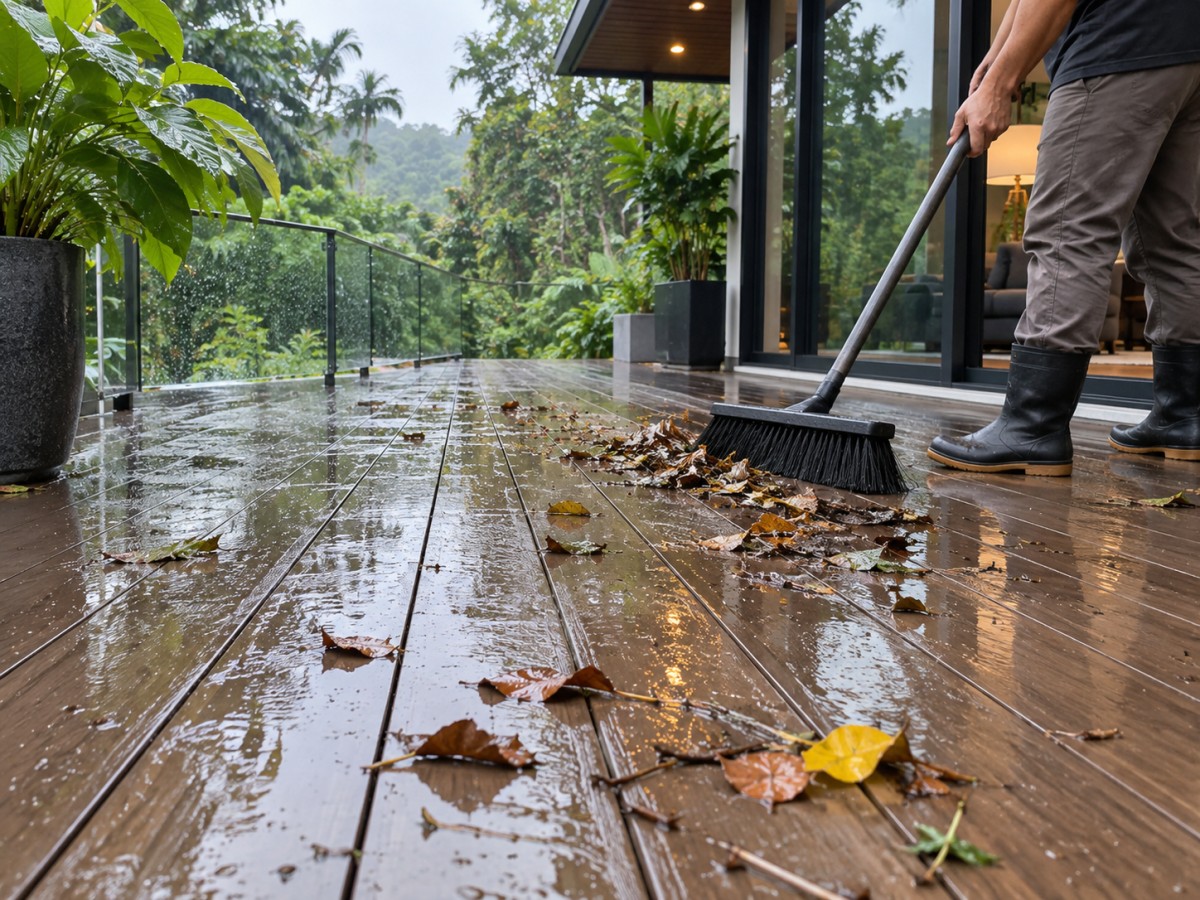
Frequent rainfall does not automatically keep WPC decking clean. Rain can wash loose dust from some areas while carrying soil, plant material and other contaminants onto the surface.
Water can also move debris towards board gaps and drains.
After periods of heavy rain, the deck should be checked for accumulated leaves or material that may restrict drainage.
Areas beside gardens can require particular attention because rain can transfer soil and organic matter onto the decking.
Routine cleaning remains necessary regardless of how often the deck becomes wet.
High Humidity and Slow Drying
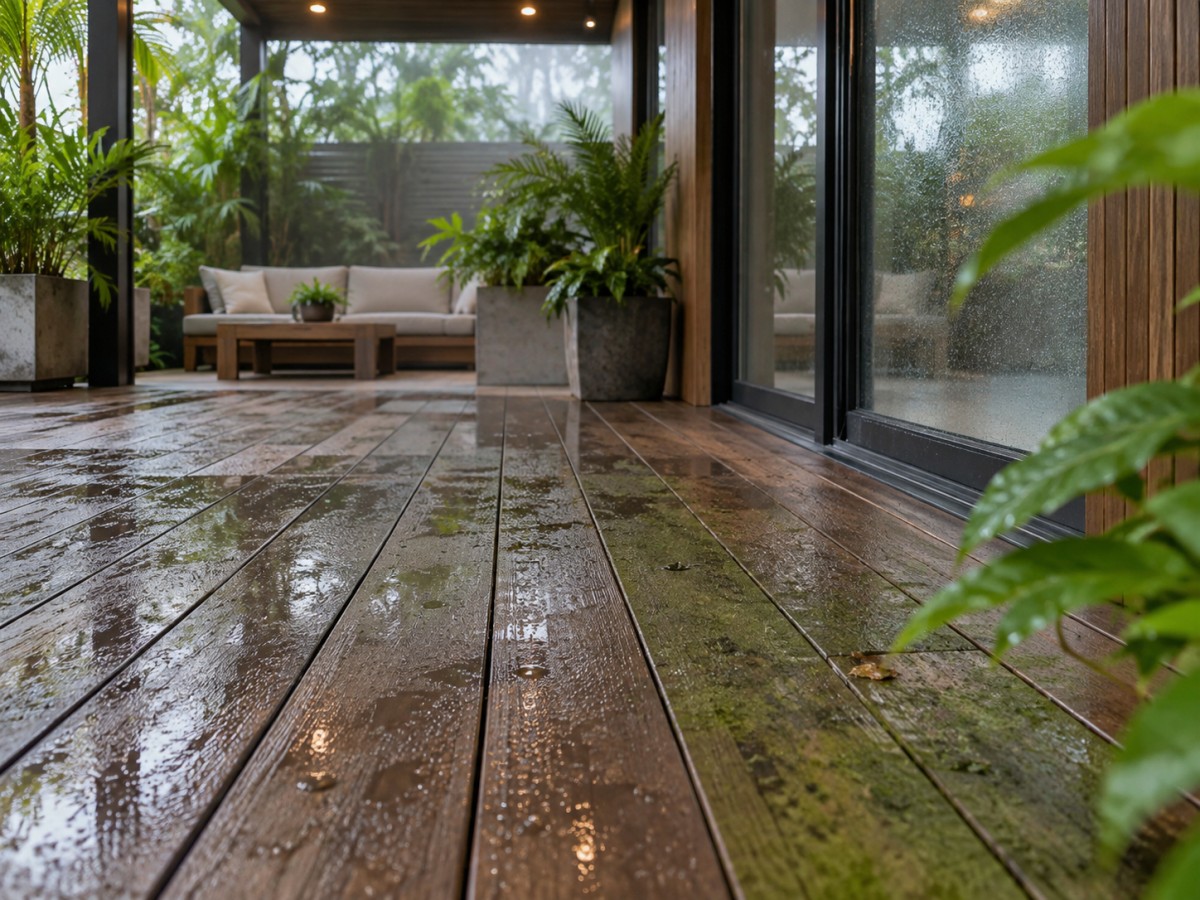
High humidity can slow evaporation after rain or washing. This is especially relevant for shaded or enclosed outdoor spaces.
A damp surface combined with dirt or organic deposits can support biological growth.
The issue is therefore not simply the presence of humidity but how humidity interacts with moisture, shade and surface contamination.
Improving drainage and airflow can help the deck dry more effectively.
Regularly removing debris also reduces the material available to support mould and algae.
Sunlight and UV Exposure
Sunlight affects outdoor composite materials differently according to their formulation, colour and surface construction. Fully exposed WPC decking generally receives greater UV and thermal exposure than covered decking.
Maintenance cannot prevent all environmental exposure.
The objective is to keep the surface clean and monitor how the product behaves in its installed environment.
Furniture and planters can create uneven exposure because the boards beneath them receive less sunlight.
Moving movable items periodically during cleaning can help expose hidden dirt and allow the condition of covered sections to be inspected.
Routine Cleaning of WPC Decking
Routine cleaning is the foundation of WPC decking maintenance because it prevents loose debris from accumulating across the surface and within board gaps. The appropriate frequency depends on the location and how the deck is used.
A relatively open balcony may collect mainly dust and airborne debris.
A garden deck may receive leaves, soil and plant material.
An outdoor restaurant terrace may experience food and beverage spills in addition to everyday foot traffic.
Cleaning frequency should therefore be based on actual conditions rather than one fixed schedule for every WPC deck.
Start by Removing Loose Debris
Loose debris should generally be removed before wet cleaning begins. This prevents leaves, soil and other material from being pushed into board gaps or drainage points.
A suitable broom or other non-damaging cleaning tool can be used to clear the surface.
Particular attention should be given to corners and edges where debris naturally accumulates.
Areas beneath movable furniture and planters should also be checked.
Removing loose material first makes subsequent washing more effective and reduces the amount of debris entering the drainage system.
Cleaning Board Gaps
Board gaps are functional parts of a WPC decking system because they support drainage and accommodate installation requirements. They should not be allowed to become heavily blocked by compacted debris.
Leaves, soil and small organic particles can collect between boards.
When these materials remain wet, they can contribute to damp conditions around the deck.
Cleaning should therefore include inspecting the gaps rather than focusing only on the visible upper surface.
Care should be taken not to damage board edges or concealed fastening components during cleaning.
Washing the WPC Surface
Washing can remove dirt that cannot be cleared through dry sweeping alone. The cleaning method should be compatible with the specific WPC product.
Water and an appropriate cleaning solution may be sufficient for routine surface cleaning depending on the manufacturer's recommendations.
Cleaning should normally work across manageable sections so loosened dirt can be removed rather than allowed to dry back onto the boards.
Any cleaning product should be rinsed or removed according to its instructions.
The surface should then be allowed to dry under normal outdoor conditions.
Choosing Cleaning Products
Cleaning products for WPC should be selected according to the board manufacturer's guidance and the type of contamination being removed. A product suitable for natural stone or solid timber is not automatically suitable for composite decking.
Harsh chemicals can affect some surfaces.
Products should therefore not be selected simply because they are described as strong outdoor cleaners.
Before treating a large area, compatibility should be confirmed.
Where appropriate, testing a cleaning method on a less visible section can help identify unexpected surface effects.
Should You Pressure-Wash WPC Decking?
Pressure washing should only be used when the specific WPC product and manufacturer guidance allow it. Excessive pressure or incorrect technique can affect certain composite surfaces.
High pressure should not be treated as the default solution for difficult dirt.
The distance, pressure and equipment used can influence the result.
A damaged surface may be more difficult to correct than the original stain.
Less aggressive cleaning methods should therefore be considered first unless the product guidance specifically supports pressure washing.
Removing Dirt and Stains
Stains on WPC decking should generally be addressed promptly because fresh contamination is often easier to manage than material that has remained on the surface for an extended period. The correct method depends on the source of the stain and the WPC product.
Outdoor decking can be exposed to several common contaminants.
These include food, drinks, cooking residue, soil, plant material and environmental dirt.
The objective is to remove the contamination without unnecessarily affecting the composite surface.
Food and Beverage Spills
Food and beverage spills should be cleaned as soon as practical, particularly on outdoor dining decks.
Solid material should first be removed without spreading it across a larger area.
The affected surface can then be cleaned using a method suitable for the WPC product.
Allowing residues to remain can make cleaning more difficult and may attract additional dirt.
Restaurants and residential outdoor dining areas may therefore require more frequent spot cleaning than decks used mainly for circulation.
Oil and Grease
Oil and grease can create noticeable marks on outdoor decking, particularly around barbecue, cooking or dining areas. Prompt attention can reduce the amount of time the contaminant remains on the surface.
The appropriate cleaning product depends on the WPC formulation.
Aggressive solvents should not automatically be used.
The manufacturer's cleaning guidance should be followed because some chemical products may alter the surface or finish.
Outdoor cooking areas can also use practical measures to reduce repeated contamination where appropriate.
Soil and Mud
Soil and mud are common on WPC garden decks and areas connected directly to landscaped spaces. Wet soil can spread across textured surfaces and settle into grooves.
Allowing heavy mud to dry partially may make loose material easier to remove before washing, depending on the situation.
The remaining residue can then be cleaned using an appropriate method.
Landscape edges should also be reviewed if soil is repeatedly washed onto the deck during rain.
Preventing recurring contamination can reduce future cleaning requirements.
Rust-Coloured or Mineral Marks
Outdoor decks can occasionally develop discolouration associated with metal components, water deposits or other environmental sources. The correct treatment depends on what caused the mark.
The source should be identified before selecting a cleaner.
Using a strong stain-removal product without understanding the cause can create unnecessary surface risk.
Fasteners, furniture and nearby metal objects should be inspected where relevant.
If the discolouration repeatedly returns, addressing the source is more useful than repeatedly treating the visible mark.
Managing Mould and Algae
Mould and algae can appear on WPC decking when moisture, shade and organic deposits create favourable growing conditions. Their presence does not necessarily mean the composite board itself is decaying.
Surface dirt can provide material on which biological growth develops.
This is why even non-timber outdoor surfaces can experience mould or algae.
Maintenance should therefore combine cleaning with moisture and environmental management.
Why Mould Can Develop on WPC
WPC contains polymer and wood-derived components, but visible mould is often associated with contamination on the surface rather than a simple conclusion that the decking material is deteriorating.
Leaves, dust, pollen, soil and other organic material can accumulate on the boards.
When these deposits remain damp in shaded areas, biological growth can develop.
Cleaning the deck regularly reduces this accumulation.
Persistent mould should also prompt inspection of drainage and airflow.
Why Algae Develops in Damp Areas
Algae commonly develops where outdoor surfaces remain moist and receive limited direct sunlight. Shaded garden decks, areas beside planting and sections close to persistent water exposure can therefore require more attention.
Algae can change the appearance and surface condition of the deck.
Removing it should form part of routine maintenance when present.
Repeated growth may indicate that water is not draining effectively or the area is remaining damp for unusually long periods.
Environmental causes should be considered alongside cleaning.
Removing Existing Mould and Algae
Existing mould or algae should be removed using a method compatible with the WPC product. The surface should first be cleared of loose debris.
A suitable cleaning product can then be applied according to its instructions.
Scrubbing equipment should not be so abrasive that it damages the board texture.
After cleaning, the area should be rinsed where required and allowed to dry.
The surrounding drainage and ventilation conditions should then be reviewed to reduce the likelihood of rapid recurrence.
Preventing Recurring Biological Growth
Preventing mould and algae requires reducing the conditions that allow them to develop. Cleaning alone may not be enough if the deck remains persistently damp.
Several practical measures can help:
These actions focus on the environment supporting the growth rather than only the visible result.
Moisture and Drainage Management
Effective drainage is one of the most important parts of WPC decking maintenance in Malaysia. Composite boards may resist moisture differently from timber, but the overall deck should still avoid unnecessary standing water.
Water passes through gaps between the boards.
It then needs a clear route beneath the deck.
Maintenance should therefore include the hidden drainage environment as far as practical.
Check Existing Drains
Existing drains beneath or beside WPC decking should remain functional. Leaves and other material can accumulate around drainage points over time.
Where the deck covers a drain, appropriate maintenance access should be preserved.
A removable access section may be useful depending on the decking design.
After heavy rainfall, checking whether water clears normally can help identify developing blockages.
A deck should not make routine drainage maintenance unnecessarily difficult.
Prevent Standing Water
Standing water can indicate blocked drainage, insufficient surface falls or another site condition requiring attention.
The response should focus on identifying why water is accumulating.
Simply cleaning the WPC boards will not resolve an underlying drainage problem.
Persistent water can also keep surrounding surfaces damp and support mould or algae growth.
Water management should therefore be treated as part of decking maintenance rather than as a separate building issue.
Keep the Under-Deck Area Clear
The area beneath raised WPC decking can accumulate leaves, soil and other material, particularly around gardens and landscaped spaces.
Where practical, this area should be inspected periodically.
Large accumulations can obstruct drainage or retain moisture.
The maintenance approach depends on how accessible the under-deck area is.
Decks should ideally be designed with future maintenance in mind rather than permanently concealing important drainage points.
Ventilation and Drying
Ventilation helps the area beneath WPC decking dry after rainfall or cleaning. Its importance depends on deck height and surrounding construction.
Low-clearance decks can have more restricted airflow.
Fully enclosed perimeter details may also affect drying conditions.
Maintenance inspections should therefore look beyond the upper board surface where possible.
If one area remains damp substantially longer than surrounding sections, the cause should be investigated.
Heat and UV Exposure
Heat and UV exposure are important considerations for WPC decking in Malaysia because open outdoor areas can receive strong sunlight for extended periods. Maintenance cannot eliminate thermal exposure, but inspection can help identify whether the decking system is accommodating it correctly.
WPC can expand and contract with temperature changes.
The installation should provide product-specific movement allowances.
Maintenance should ensure these gaps remain functional.
Inspect Expansion Gaps
Expansion gaps should not become filled with hard debris or other material that restricts intended movement.
Areas where boards meet walls, columns or other fixed structures deserve particular attention.
If a board appears to be pressing against a fixed boundary, the condition should be assessed rather than ignored.
Required clearances vary by WPC product.
Any correction should therefore follow the specifications of the installed system.
Check Board Ends and Joints
Board ends and joints can reveal changes related to thermal movement or fastening.
Periodic inspection can identify unusual displacement or contact between components.
Minor dimensional changes may reflect normal material behaviour.
Significant or recurring movement should be assessed in relation to the fastening system, substructure and product requirements.
The objective is to identify whether the deck is functioning as designed.
Shade and Surface Temperature
Shade can reduce direct solar exposure and influence how hot WPC decking becomes during the day. It can also slow drying after rainfall.
This creates a maintenance trade-off.
Highly exposed areas may experience greater heat and UV, while shaded areas may remain damp longer and require more mould or algae management.
The maintenance approach should therefore reflect the actual exposure of each section rather than assuming the entire deck experiences identical conditions.
Cleaning Around Furniture and Planters
Furniture and planters can create hidden areas where dirt and moisture accumulate. These sections should be included during routine cleaning.
Movable items can be repositioned periodically to allow access beneath them.
Planters deserve particular attention because soil and irrigation water can repeatedly reach the decking surface.
Suitable supports or trays may help manage direct contact where appropriate.
Heavy objects should also be positioned according to the structural requirements of the deck.
WPC Maintenance for Balconies
Balcony WPC decking often requires attention to drainage, dust accumulation and areas beneath furniture. High-rise balconies can still receive substantial rain and sunlight.
Floor drains should remain accessible.
Wind can carry leaves and debris into corners even where there is little nearby vegetation.
Balconies enclosed by walls may also have different drying conditions from open terraces.
Maintenance should therefore include checking corners, perimeter gaps and drainage outlets.
WPC Maintenance for Garden Decks
Garden WPC decking commonly requires more debris management because of nearby soil, leaves, flowers and vegetation.
Board gaps should be checked regularly.
Plants should not be allowed to create permanently damp areas where practical.
Soil repeatedly washed onto the deck may indicate that landscape edging or drainage should be reviewed.
Garden maintenance and decking maintenance are therefore closely connected.
WPC Maintenance Around Pools
Poolside WPC decking requires routine cleaning because frequent water exposure can combine with sunscreen, environmental dirt and other residues.
Drainage should remain effective.
Surface condition should also be monitored because pool decks are frequently used barefoot.
Strong sunlight can increase surface temperature, while shaded sections may develop different moisture conditions.
Maintenance should therefore consider both wet-use conditions and solar exposure.
WPC Maintenance for Commercial Spaces
Commercial WPC decking can require more frequent maintenance because of foot traffic, food and beverage spills, furniture movement and operational use.
A planned cleaning routine can help maintain consistency across larger areas.
Staff should also know which cleaning products are compatible with the decking.
Periodic inspections should include high-traffic routes, furniture areas, entrances and drainage points.
Localised issues can then be addressed before they affect a larger section.
Long-Term Care and Inspection
Long-term WPC care should include periodic inspection of the entire decking system rather than focusing only on surface cleanliness. Boards, fasteners, substructure, drainage and movement gaps all contribute to performance.
The inspection frequency depends on exposure and use.
A heavily used commercial deck may need more frequent checks than a lightly used residential balcony.
Additional inspection can also be useful after unusually severe weather or changes to the surrounding area.
Inspect Boards for Physical Changes
WPC boards should be checked for unusual movement, damage or changes that affect their function.
Surface scratches or marks should be distinguished from structural issues.
Board ends, edges, and high-traffic sections deserve particular attention.
If physical change repeatedly occurs in the same location, the underlying support or fastening should also be assessed.
Replacing a visible component without identifying the cause may not provide a lasting solution.
Inspect Clips and Fasteners
Clips and fasteners should remain secure and correctly positioned.
Loose components can affect board alignment and movement.
The fastening system may be partially concealed, so inspection methods depend on the deck design.
Raised, damaged or missing components should be assessed using parts compatible with the installed WPC system.
Substituting unrelated fasteners without checking compatibility can affect the board or fixing arrangement.
Inspect the Substructure
The substructure supports the entire deck and should be included in maintenance where it is accessible.
Check for changes in level, movement or conditions that affect support.
Persistent moisture around the framework should also be investigated.
The maintenance requirements of the substructure depend on its material and design.
A clean WPC surface does not compensate for an unstable supporting system.
Common WPC Decking Maintenance Mistakes
WPC maintenance problems often result from treating composite decking as either completely maintenance-free or identical to natural timber. Both assumptions can lead to inappropriate care.
Several mistakes are particularly important to avoid.
Allowing Debris to Accumulate
Leaves and soil can retain moisture and block drainage gaps.
Routine removal is easier than dealing with heavily compacted debris later.
Using Any Outdoor Cleaner
Cleaning chemicals designed for other surfaces may not be suitable for WPC.
Product compatibility should be confirmed first.
Using Excessive Cleaning Force
Highly abrasive scrubbing or uncontrolled pressure washing can affect some composite surfaces.
The least aggressive effective method is generally preferable.
Ignoring Drainage
A clean surface can still have problems if water remains trapped beneath it.
Drainage should form part of every maintenance programme.
Assuming Mould Means the WPC Is Rotting
Surface mould can develop on organic deposits without proving that the composite board itself is structurally deteriorating.
The surface and environmental conditions should be assessed separately.
Ignoring Thermal Movement
WPC can expand and contract with temperature.
Movement gaps and board ends should therefore remain part of long-term inspection.
A Practical WPC Decking Maintenance Routine
A practical maintenance routine combines regular cleaning with periodic system inspection. The exact timing should respond to the environment rather than follow an inflexible schedule.
The following sequence provides a useful framework:
More frequent attention may be appropriate for gardens, pool areas and commercial decks.
Frequently Asked Questions (FAQs)
Does WPC decking need regular maintenance?
Yes. WPC requires routine cleaning, stain management, drainage checks and periodic inspection. It generally requires less timber-specific appearance maintenance than natural wood but should not be considered maintenance-free.
How often should WPC decking be cleaned?
There is no single cleaning frequency suitable for every deck. Cleaning should respond to the amount of dirt, leaves, moisture and traffic affecting the space, with garden, poolside and commercial decks often requiring more frequent attention.
How do you clean WPC decking?
Start by removing loose debris and checking board gaps. The surface can then be cleaned using methods and products compatible with the specific WPC system, following the manufacturer's guidance where available.
Can I pressure-wash WPC decking?
Pressure washing should only be used when permitted for the specific WPC product. Excessive pressure or incorrect technique can affect some composite surfaces, so product guidance should be checked first.
Can WPC decking develop mould?
Yes. Mould can develop on dirt and organic deposits when moisture and shade create favourable conditions. Routine cleaning, effective drainage and improved drying conditions help manage recurrence.
How do I prevent algae on WPC decking?
Keep the surface free from organic debris, maintain clear drainage and address areas that remain persistently damp. Shaded sections may require more frequent cleaning than exposed areas.
Does WPC decking need sealing?
WPC products do not all have identical surface constructions, so sealing should not be assumed necessary. Follow the maintenance guidance for the actual product rather than applying timber or stone treatments automatically.
How should stains on WPC be treated?
Stains should be addressed promptly using a cleaning method compatible with the board. The appropriate treatment depends on whether the mark comes from food, oil, soil, metal or another source.
Should WPC expansion gaps be cleaned?
Yes. Movement and drainage gaps should remain reasonably clear of compacted debris. Material lodged around board ends or fixed boundaries can interfere with the intended decking system.
Is WPC easier to maintain than timber?
WPC generally reduces timber-specific appearance maintenance such as refinishing to preserve natural wood colour. Both materials still require routine cleaning, drainage management and inspection, so the difference is primarily in the type of maintenance required.
Keeping WPC Decking Functional in Tropical Conditions
WPC decking maintenance in Malaysia should focus on keeping the surface clean, allowing rainwater to drain and ensuring the complete decking system continues to function under humid and sunny outdoor conditions.
Composite decking does not require the same appearance-focused care as natural timber, but dirt, stains, mould and algae can still develop. Routine cleaning is therefore necessary, particularly in shaded gardens, poolside areas and frequently used commercial spaces.
Drainage and ventilation also remain important. Malaysia's frequent rain means blocked board gaps or drains can keep areas damp for longer, creating conditions that increase cleaning requirements.
Long-term maintenance should extend beyond the visible boards. Fasteners, expansion gaps, substructure and drainage points all contribute to the performance of the deck.
A consistent approach based on the actual environment and WPC product can help keep the outdoor surface practical, clean and appropriately maintained without treating composite decking as either maintenance-free or the same as natural timber.