
WPC decking is an outdoor decking material manufactured by combining wood-derived material with plastic polymers and other components to form composite decking boards. Understanding what WPC decking involves means looking at its composition, manufacturing process, weather behaviour, installation requirements and maintenance rather than treating it as simply an artificial version of timber.
WPC stands for Wood Plastic Composite. Unlike natural timber decking, which consists primarily of solid wood, WPC material is manufactured to create boards with controlled dimensions, profiles, surface textures and performance characteristics.
For outdoor applications in Malaysia, WPC decking can be considered for balconies, patios, gardens, poolside areas and suitable commercial spaces. Its manufactured composition can reduce some of the appearance-focused maintenance associated with natural timber, although WPC still requires cleaning, drainage and correct installation.
Malaysia's rainfall, humidity, strong sunlight and warm outdoor temperatures also remain important. WPC does not behave exactly like timber, but it still responds to environmental conditions, particularly heat and thermal movement.
What WPC Decking Means
WPC decking means Wood Plastic Composite decking, a manufactured outdoor flooring system made using a combination of wood-derived material and polymer. The exact formulation differs between manufacturers and products.
The wood component may be present as wood fibre, wood flour or another processed wood-derived material.
The polymer component helps bind the composite and contributes to characteristics such as moisture resistance and dimensional behaviour.
Additional ingredients may also be incorporated depending on the product design.
The result is a decking board engineered for installation as part of an outdoor flooring system.
Is WPC the Same as Natural Timber?
WPC is not the same as natural timber because it is a composite material rather than solid wood. Although many WPC boards are designed to provide a wood-inspired appearance, their internal composition and environmental behaviour are different.
Natural timber has continuous wood grain created by tree growth.
WPC uses processed wood-derived material combined with polymer and other ingredients.
This distinction affects how the materials respond to moisture, heat, UV exposure and maintenance.
WPC should therefore be installed according to the requirements of the specific composite system rather than using assumptions based on natural timber decking.
Is WPC the Same as Plastic Decking?
WPC is not simply plastic decking because it contains wood-derived material as part of the composite formulation. The relative proportions and types of components vary by manufacturer.
Fully synthetic decking products can use polymer without the same wood-derived component found in conventional WPC.
WPC occupies a different material category because it combines these components into one manufactured board.
The term "composite decking" is broader and can cover different product formulations, so the actual material specification should always be reviewed.
Wood-Plastic Composite Materials
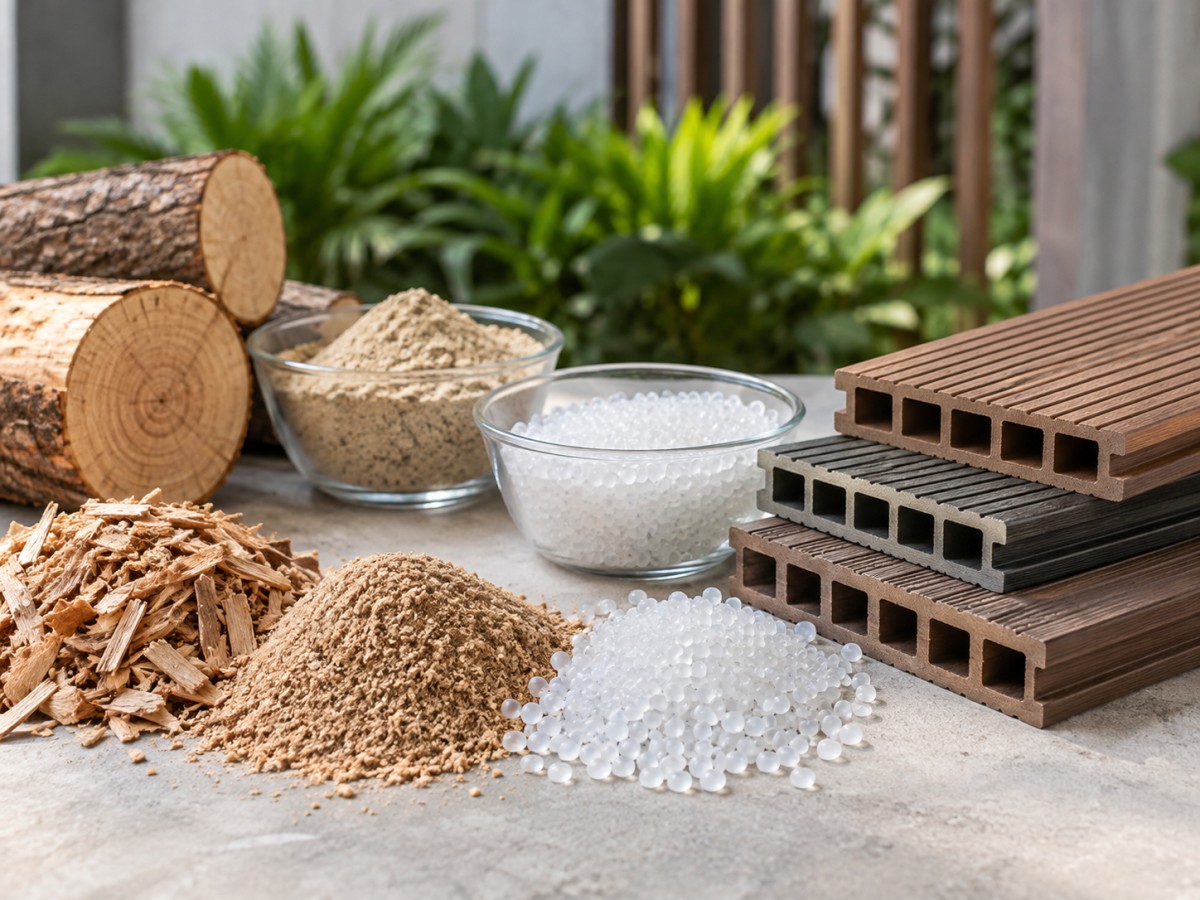
Wood-plastic composite material is created by combining wood-derived particles or fibres with a thermoplastic polymer and other formulation components. These ingredients are processed together to form a relatively consistent material.
The exact composition is product-specific.
This means two WPC decking boards can look similar while differing in density, profile, surface layer, polymer type and other characteristics.
The material name alone does not provide every detail needed to evaluate a product.
Product specifications and installation requirements should therefore form part of the selection process.
The Wood Component in WPC
The wood component provides part of the composite's structure and contributes to its wood-based characteristics. It is generally processed into a smaller form before being combined with polymer.
Wood flour or wood fibres can be used depending on the manufacturing system.
Unlike a natural timber board, these particles do not retain the continuous grain structure of solid wood.
This allows the manufacturer to create a more consistent composite material.
The amount and type of wood-derived content can differ between WPC products, which is one reason performance should be evaluated at the product level rather than assuming every composite board behaves identically.
The Polymer Component in WPC
The polymer component binds the wood-derived material and contributes to the composite's moisture and physical characteristics. Different WPC formulations can use different thermoplastic polymers.
Polyethylene is one polymer associated with some wood-plastic composite products, although formulations vary.
The polymer contributes to how the board behaves when exposed to water and temperature changes.
It also means WPC responds to heat differently from natural timber.
Thermal expansion and contraction should therefore be considered during installation.
Other Components in WPC Material
WPC formulations may contain additional ingredients used to influence manufacturing or product characteristics. The exact combination depends on the manufacturer.
These can include pigments and other additives used for purposes such as colour, processing or environmental performance.
The presence of additives does not make all WPC boards equivalent.
Different formulations can create differences in appearance, surface characteristics and behaviour outdoors.
For this reason, buyers should review the specific product information rather than relying only on the WPC label.
How WPC Boards Are Manufactured
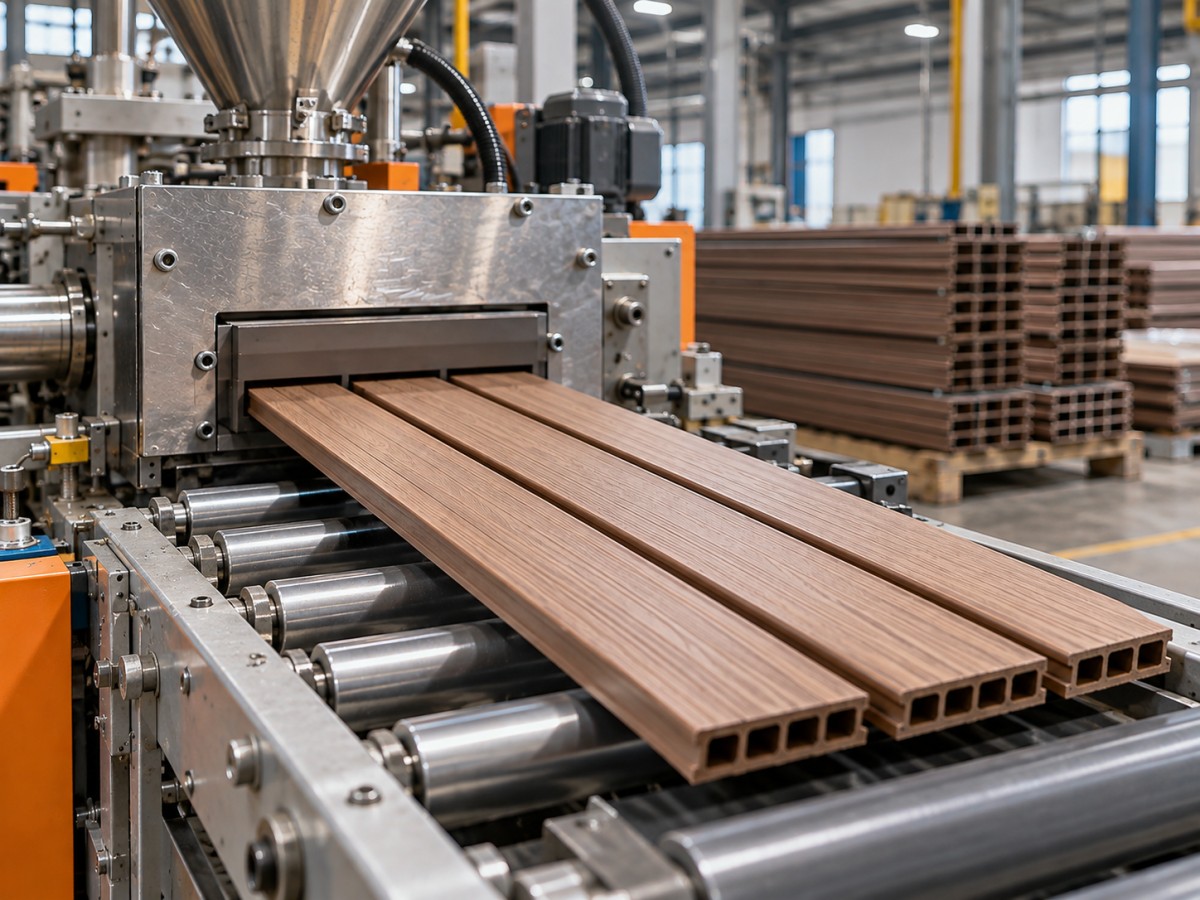
WPC decking boards are manufactured by blending their component materials and forming the mixture into a controlled profile. This process allows manufacturers to produce boards with repeatable dimensions and designed surface features.
Manufacturing methods vary, but extrusion is commonly associated with WPC production.
During extrusion, the prepared composite mixture is processed and pushed through equipment that forms the required board profile.
The resulting board can then receive additional surface finishing depending on the product.
This manufacturing process distinguishes WPC from solid timber boards, which are cut and machined from natural wood.
Material Preparation
WPC manufacturing begins with preparing the wood-derived and polymer components to meet the requirements of the formulation.
Consistency is important because the components need to combine effectively during processing.
The materials are mixed according to the product design.
Pigments or other formulation ingredients may also be introduced at this stage.
The prepared mixture then moves into the board-forming process.
Extrusion and Board Formation
Extrusion forms the composite mixture into a continuous decking profile. The material is processed under controlled manufacturing conditions and shaped through a die.
The board profile is determined by the product design.
Some boards are relatively solid internally, while others incorporate hollow sections.
Grooves or other features may also be incorporated to support a particular fastening system.
After forming, the material is cooled and prepared for further finishing or cutting.
Surface Texturing
WPC decking can be manufactured with different surface textures and patterns. Many products use wood-inspired textures to create an appearance related to timber decking.
The texture is manufactured rather than naturally grown.
This can provide more visual consistency between boards than solid timber.
Surface design can also influence cleaning and how dirt accumulates.
A deeply textured board may require a different cleaning approach from a smoother surface.
Appearance should therefore be considered alongside practical maintenance.
Solid and Hollow WPC Boards
WPC decking boards can use different internal profiles, including solid and hollow designs. These profiles are not interchangeable descriptions of quality.
A solid board contains composite material through most or all of its cross-section.
A hollow board contains designed internal voids.
The profile affects board weight, fastening requirements, support and other product-specific characteristics.
The appropriate choice depends on the manufacturer, intended application and installation system.
Joist spacing and fastening requirements should follow the specifications of the actual board rather than assumptions based only on whether it is solid or hollow.
Capped and Uncapped WPC Decking
Some WPC products incorporate an outer protective layer commonly described as a cap, while others use an uncapped composite surface. These constructions create different surface systems.
Capped WPC typically uses an additional polymer-based layer around part or all of the composite core, depending on the product.
This layer can influence moisture interaction, staining behaviour and surface appearance.
Uncapped WPC exposes the composite material itself at the surface.
Neither term alone determines suitability.
The complete product specification should be considered for the intended outdoor environment.
Key Material Characteristics of WPC Decking
WPC decking combines manufactured consistency with characteristics designed for exterior flooring applications. Its behaviour differs from both solid timber and fully mineral outdoor surfaces.
Several characteristics are particularly relevant when considering WPC material for Malaysian outdoor spaces.
Manufactured Board Consistency
WPC boards are manufactured to controlled dimensions and profiles. This generally provides greater consistency in board shape and surface design than natural timber.
Natural timber can contain variations in grain, colour and other characteristics because every board originates from a tree.
WPC is produced through a manufacturing process.
This makes it relevant for projects where a more consistent visual pattern is preferred.
Some variation can still occur between production batches or product ranges, so actual samples and specifications remain useful.
Moisture Behaviour
WPC is manufactured to provide different moisture behaviour from natural solid timber. Its polymer component reduces the extent to which the board behaves like untreated solid wood when exposed to water.
This does not mean WPC should be installed in permanently wet conditions without drainage.
Rainwater still needs somewhere to go.
Standing water, blocked drains and persistent organic debris can affect the cleanliness and surrounding decking system even when the board itself is composite.
Moisture resistance should therefore support good drainage rather than replace it.
Dimensional Behaviour
WPC decking can expand and contract in response to temperature changes. This thermal movement is different from the moisture-driven movement commonly associated with natural timber.
Outdoor temperatures can vary substantially between shaded and sun-exposed conditions.
The board length and product formulation can influence how this movement needs to be accommodated.
Installation gaps at board ends, edges and fixed structures should therefore follow the product's requirements.
Ignoring thermal movement can affect the finished decking system.
Surface Characteristics
WPC decking surfaces can be manufactured with different textures, colours and finishes. These features influence both appearance and practical use.
Surface texture can affect how dirt, water and environmental deposits behave.
Colour can influence visual design and heat absorption.
The selected surface should therefore be assessed for the intended environment rather than selected from appearance alone.
Poolside, balcony and commercial applications may place different demands on the surface.
WPC Decking and Malaysia's Weather
WPC decking can be used in Malaysia's tropical environment when the specific product and installation system are suitable for outdoor exposure. Rainfall, humidity, UV radiation and heat remain relevant despite the material being manufactured.
Composite decking does not remove climate from the design process.
It simply responds to the climate differently from natural timber.
WPC and Heavy Rain
WPC decking can be exposed to rainfall, but the deck still needs effective water management. Board gaps and the underlying surface should allow rainwater to leave the area.
Water should not be intentionally trapped beneath the deck.
Existing drains should remain functional and accessible where maintenance is required.
In Malaysia, sudden heavy rainfall can place substantial demand on outdoor drainage.
The decking layout should therefore be planned around the site's existing or proposed drainage rather than covering it without assessment.
WPC and High Humidity
High humidity is relevant to the overall decking environment even though WPC does not respond to atmospheric moisture in the same way as solid timber.
Humidity can contribute to slow drying of surrounding surfaces.
Shaded decks may therefore remain damp after rainfall.
Organic debris can also remain moist and support surface growth.
Good ventilation and routine cleaning remain useful because the performance of an outdoor deck includes more than the board material itself.
WPC and UV Exposure
UV exposure can affect outdoor materials, including composite decking. The degree of change depends on the product formulation, surface layer, colour and exposure.
Fully exposed decks receive more solar radiation than covered areas.
Manufacturers may design products to manage outdoor UV exposure, but the actual product specification should be reviewed.
Colour change or weathering characteristics can differ between WPC products.
A sample should therefore be considered together with information about expected outdoor behaviour.
Does WPC Decking Get Hot?
WPC decking can become hot when exposed to direct sunlight. Surface temperature depends on colour, formulation, exposure duration, airflow and surrounding conditions.
Dark surfaces generally warrant particular consideration in areas receiving prolonged direct sun.
This is especially relevant for pool decks, balconies and patios frequently used barefoot.
Shade can significantly change the experience of the same material.
Pergolas, roofs, umbrellas, trees and other shading elements should therefore be considered as part of outdoor comfort planning.
Heat and Thermal Expansion
Heat affects WPC in two important ways: surface temperature and material expansion. These are related but separate considerations.
Surface temperature affects user comfort.
Thermal expansion affects installation.
A board exposed to strong sunlight can expand as its temperature rises and contract when conditions cool.
Correct installation gaps help accommodate this movement.
The required dimensions should follow the specifications for the particular WPC product rather than a universal rule.
Weather and Moisture Performance
Weather performance describes how WPC functions under outdoor exposure rather than whether it can avoid environmental effects completely. The complete decking system should be designed around local conditions.
Moisture resistance is one advantage often associated with WPC compared with natural timber, but drainage remains necessary.
Heat and UV exposure also require consideration.
The best-performing system is therefore one in which the material, supporting structure, board spacing and site conditions are compatible.
Drainage Requirements for WPC Decking
WPC decking requires effective drainage because rainwater needs to leave the surface and under-deck area. Composite boards should not be used to conceal unresolved standing-water problems.
Board gaps allow water to pass through.
The underlying floor or landscape should then direct it towards suitable drainage.
Substructure components should not unnecessarily block this route.
Drainage points should also remain accessible where periodic clearing is required.
Ventilation Beneath WPC Decking
Ventilation can help the space beneath WPC decking dry after rainfall and cleaning. This is particularly useful for low-clearance decks in humid or shaded areas.
Ventilation requirements depend on the specific decking system.
The installation should follow the manufacturer's recommendations.
Enclosing the perimeter without considering airflow can change drying conditions beneath the deck.
Drainage and ventilation should therefore be considered together during planning.
Appearance and Surface Options
WPC decking is available in a range of manufactured colours, textures and board profiles. This allows the surface to be selected according to the architectural character of the outdoor space.
Many WPC products use wood-inspired embossing or texturing.
Others may provide more contemporary surface designs.
The visual result is generally more controlled than natural timber because the boards are manufactured.
However, the choice should still consider how the material will look under natural sunlight and after outdoor exposure rather than relying only on indoor samples.
WPC Compared With Natural Timber Appearance
WPC can imitate aspects of timber appearance, but it remains a manufactured composite rather than natural wood. The distinction is visible in how the surface pattern and variation are created.
Natural timber has unique grain on every board.
WPC surface texture is created during manufacturing.
For buyers who prioritise authentic grain and natural ageing, timber may align more closely with that preference.
For those who prefer greater consistency in colour and pattern, WPC may be worth considering.
Neither characteristic makes one material universally preferable.
Installation Requirements for WPC Decking
WPC decking should be installed according to the requirements of the specific product because board profiles, thermal movement and fastening systems vary. Natural timber installation assumptions should not automatically be transferred to WPC.
The manufacturer or system supplier should provide relevant installation specifications.
These commonly address substructure, joist spacing, board gaps and fastening.
Site Assessment
Site assessment determines whether the location can support the proposed WPC decking system.
Existing drainage, available height, door thresholds and structural conditions should be reviewed.
Balconies may have limited clearance.
Garden installations may require a different supporting approach.
Poolside areas need to account for frequent wetting and drainage.
The WPC board should be selected only after these site conditions are understood.
Substructure
The substructure provides support beneath WPC boards and transfers loads to the underlying surface.
Joist spacing should match the requirements of the actual board.
Hollow and solid profiles may have different installation specifications.
The framework should also support drainage and ventilation where required.
An inappropriate substructure can affect the deck regardless of the quality of the visible WPC boards.
Board Spacing
WPC boards require appropriate spacing because thermal expansion and contraction occur with temperature changes.
Spacing requirements can include gaps between adjacent boards, board ends and fixed structures.
The required dimensions depend on the product.
Installing boards too tightly can restrict expected movement.
Excessive spacing can also affect the finished appearance and function.
Product-specific instructions should therefore guide installation.
Fastening Systems
WPC decking commonly uses fastening systems designed for the particular board profile. Some systems use clips installed between grooved board edges, reducing visible fasteners across the main surface.
Other profiles may use different fixing methods.
The fastening system should be compatible with the board and substructure.
Clips should not be assumed to provide the same gap or movement allowance for every WPC product.
The complete system should be installed according to its specifications.
Expansion at Walls and Fixed Structures
WPC should have a suitable allowance where boards meet walls, columns or other fixed structures. Thermal movement can otherwise create pressure against these boundaries.
The required clearance depends on board length, product formulation and installation conditions.
This is particularly relevant for long runs of decking.
Planning these details before installation helps avoid unnecessary adjustments after the boards have already been fixed.
Maintenance and Cleaning
WPC decking is generally associated with lower appearance-focused maintenance than natural timber because it does not require the same approach to preserving natural wood colour. It still requires routine cleaning and inspection.
Low maintenance does not mean no maintenance.
Outdoor surfaces collect dirt, leaves, food residue and environmental deposits regardless of their material.
Routine WPC Cleaning
Routine cleaning removes loose debris before it accumulates across the surface or within board gaps.
Leaves and soil should be cleared regularly.
Outdoor dining areas may also need prompt attention to spills.
The appropriate cleaning method depends on the product.
Manufacturer guidance should be followed when selecting cleaning products or equipment.
Managing Mould and Algae
Mould and algae can develop on the surface of WPC decking when environmental conditions support biological growth. Moisture, shade and organic debris can contribute.
The composite material itself does not need to decay for surface growth to occur.
Dirt and organic deposits can provide material on which biological growth develops.
Recurring mould or algae should therefore prompt inspection of drainage, cleaning and surrounding vegetation.
Improving drying conditions can complement surface cleaning.
Stain Management
WPC decking can still develop stains from food, drinks, oils, soil and other outdoor contaminants. The response depends on the surface and product formulation.
Spills should generally be addressed before they remain on the surface for prolonged periods.
Cleaning methods should be compatible with the product.
Aggressive chemicals should not be used without confirming suitability.
A stain-resistant product should not automatically be interpreted as impossible to stain.
Long-Term Inspection
WPC decking should be inspected periodically for physical changes in the boards, fasteners and substructure.
Important areas include board ends, perimeter gaps and sections around drains.
Fasteners or clips should remain secure.
Changes in the supporting structure should also be investigated.
The visible composite board is only one component of the decking system, so maintenance should include what supports and surrounds it.
Common WPC Decking Applications
WPC decking can be considered for residential, landscape and commercial outdoor environments where its manufactured characteristics align with the project requirements.
The suitability of the actual product should still be confirmed for the intended application.
Balcony Decking
WPC can be used for suitable balconies where drainage, installation height and building requirements permit.
Balcony decks may experience direct sun, wind-driven rain and changing surface temperatures.
Existing drains should remain functional.
Thermal movement should also be accommodated, particularly where boards run between fixed walls.
Patio and Terrace Decking
WPC can provide an outdoor surface for patios and terraces used for seating, dining and general outdoor living.
Covered and uncovered areas create different exposure conditions.
Open terraces may receive prolonged sunlight and rainfall.
Covered patios may experience less UV but remain humid after rain.
The product should therefore be selected according to the actual environment rather than the space name alone.
Garden Decking
WPC can be incorporated into garden decks, platforms and landscaped outdoor areas.
Garden environments introduce leaves, soil and other organic material.
Routine cleaning remains important.
The substructure should suit the ground conditions and allow effective drainage.
Surrounding vegetation should also be managed so it does not unnecessarily obstruct airflow or access.
Poolside Decking
WPC may be considered for suitable poolside applications where the product's surface characteristics, drainage and heat performance match the project.
Frequent wetting should be expected.
Direct sunlight can also increase surface temperature.
Poolside material selection should therefore consider both wet conditions and barefoot comfort.
The surface should be cleaned routinely to manage environmental deposits.
Commercial Decking
WPC can be used in suitable commercial environments such as outdoor dining spaces, hospitality areas and selected pedestrian zones.
Commercial applications can involve higher traffic and more frequent cleaning.
The decking product and supporting system should be suitable for the expected use.
Maintenance access should also be considered because larger areas require structured inspection and cleaning.
WPC Decking Applications at a Glance
Different applications place different demands on WPC decking. A concise comparison helps identify the main considerations.
| Application | Key Considerations |
|---|---|
| Balcony | Drainage, installation height, thermal movement, sunlight |
| Patio | Furniture, cleaning, rain and shade exposure |
| Garden | Ground conditions, leaves, drainage, ventilation |
| Poolside | Frequent wetting, surface temperature, drainage, cleaning |
| Commercial | Traffic, maintenance access, system suitability |
The actual WPC product should be evaluated against these conditions before selection.
Advantages and Considerations of WPC Decking
WPC offers several practical characteristics, but they should be considered together with product-specific limitations and site requirements.
Its manufactured composition can provide:
At the same time, WPC still requires drainage, cleaning and allowance for thermal movement.
The material should therefore be selected according to its complete performance requirements rather than being described simply as maintenance-free decking.
Common Misconceptions About WPC Decking
WPC decking is sometimes described using simplified claims that do not reflect how composite materials actually function outdoors. Understanding these misconceptions helps establish realistic expectations.
WPC Is Completely Maintenance-Free
WPC still requires routine cleaning and inspection.
Leaves, dirt, stains and biological growth can affect any outdoor surface.
WPC Does Not Expand
WPC can expand and contract with temperature changes.
Correct installation spacing is therefore important.
WPC Cannot Become Hot
WPC can become hot under direct sunlight.
Colour, exposure and product formulation influence surface temperature.
WPC Does Not Need Drainage
Rainwater still needs somewhere to go.
Board gaps and under-deck drainage remain important.
All WPC Decking Is the Same
Different WPC products use different formulations, profiles, surfaces and manufacturing systems.
Product specifications should therefore be compared directly.
What to Check Before Choosing WPC Decking
WPC should be evaluated at the product level because the term covers different formulations and board systems. Clear specifications make comparison more meaningful.
Before choosing a WPC product, review:
These details provide more useful information than selecting a product based only on colour or surface texture.
Frequently Asked Questions (FAQs)
What does WPC decking mean?
WPC means Wood Plastic Composite decking. It is a manufactured decking material that combines wood-derived material with plastic polymer and other formulation components.
Is WPC decking made from real wood?
WPC contains wood-derived material such as wood fibre or wood flour, but it is not solid natural timber. The wood component is combined with polymer to form a composite board.
Is WPC decking waterproof?
WPC has different moisture behaviour from natural timber, but it should not be treated as a reason to ignore drainage. Rainwater still needs to leave the decking surface and under-deck area effectively.
Does WPC decking expand?
Yes. WPC can expand and contract in response to temperature changes. Appropriate installation gaps should follow the requirements of the specific product.
Does WPC decking get hot in Malaysia?
WPC can become hot when exposed to strong direct sunlight. Surface temperature depends on colour, product formulation, duration of exposure, airflow and shade.
Does WPC decking need maintenance?
Yes. WPC requires routine cleaning and inspection even though it generally does not require the same appearance-focused refinishing associated with natural timber.
Can mould grow on WPC decking?
Mould or algae can develop on surface dirt and organic deposits when moisture and shade create favourable conditions. Regular cleaning and effective drainage help manage these conditions.
Can WPC decking be installed around a swimming pool?
Suitable WPC products may be considered for poolside applications. Surface characteristics, drainage, heat exposure, cleaning and the manufacturer's intended-use guidance should be evaluated first.
Can WPC decking be installed on balconies?
Yes, suitable WPC systems can be considered for balconies where installation height, drainage, thermal movement and applicable building requirements are addressed.
Is WPC better than natural timber?
WPC and natural timber have different characteristics rather than one being universally better. WPC offers manufactured consistency and different maintenance requirements, while timber provides genuine natural grain and natural weathering. The appropriate choice depends on the project.
Understanding WPC as a Complete Outdoor Decking System
WPC decking is a manufactured composite material that combines wood-derived material with polymer to create boards designed for outdoor flooring applications. Its composition gives it different characteristics from natural timber, particularly in moisture behaviour, appearance consistency and thermal movement.
For Malaysian outdoor spaces, WPC can be considered for balconies, patios, gardens, poolside areas and suitable commercial applications. Rainfall, humidity, sunlight and heat still need to be addressed through material selection and proper construction.
Correct installation remains fundamental. The substructure, joist spacing, board gaps, fastening system, drainage and ventilation should match the requirements of the specific WPC product.
Maintenance also remains necessary even when the material is described as low maintenance. Routine cleaning, stain management, drainage inspection and monitoring of boards and fasteners help support the complete decking system.
Understanding what WPC decking is, therefore, means looking beyond the composite board itself. The material performs most effectively when its manufactured characteristics are matched with the environment, installation system and intended use of the outdoor space.