
WPC decking is an engineered outdoor flooring material made by combining wood-based fibres or particles with polymers and other formulation components. For Malaysian properties, it provides an alternative to natural timber where consistent board dimensions, manufactured finishes and reduced timber-specific maintenance are important considerations.
Malaysia's tropical environment is particularly relevant. Outdoor decking can be exposed to frequent rainfall, high humidity, strong sunlight and elevated surface temperatures throughout the year. WPC is designed for outdoor applications, but it still needs to be selected and installed according to the conditions of the site.
Wood-plastic composite decking also varies between manufacturers and product ranges. The proportion and type of wood material, polymer, additives, surface treatment and board construction can differ, meaning the term "WPC" does not describe one universal product specification.
In this WPC decking guide in Malaysia, we explain more than just the difference between composite and natural wood. We will elaborate on how the composition of the boards, manufacturing method, board profile, weather exposure, thermal movement, substructure, drainage and cleaning requirements all influence how a composite deck performs.
What Is WPC Composite Decking?
WPC composite decking is a manufactured decking material containing a combination of wood-derived material and thermoplastic polymers. These components are processed into boards designed to provide a stable and repeatable outdoor flooring system.
WPC stands for wood-plastic composite. Depending on the formulation, the wood component may consist of wood flour, fibres or other processed wood material, while the polymer component may include polyethylene or another suitable thermoplastic.
Additional components can be incorporated into the formulation to support manufacturing, colour, stability or other product characteristics.
A typical WPC board can therefore contain:
- ✓ Wood fibres, wood flour or another wood-derived component
- ✓ A thermoplastic polymer such as polyethylene
- ✓ Pigments that determine the manufactured colour
- ✓ Additives used for processing or material performance
- ✓ Surface treatments or protective layers on certain product types
The exact formulation is product-specific. Buyers should avoid assuming that two WPC boards have identical characteristics simply because both are described as composite decking.
How WPC Decking Is Made
WPC decking is generally manufactured by combining prepared wood-based material with polymers and other components before forming the mixture into a continuous board profile. The manufacturing process gives composite boards their controlled dimensions and repeatable shapes.
Production methods vary, but extrusion is commonly associated with WPC manufacturing. The blended material is heated and processed through equipment that forms it into the required board profile.
After forming, the boards are cooled and may receive additional surface texturing, brushing, embossing or protective treatments depending on the product design.
Preparing the Wood Component
Wood material used in WPC is processed into a form suitable for controlled manufacturing. This may involve fine wood particles or fibres rather than solid timber.
Moisture and particle consistency can be important during production because they influence how the components combine.
The wood material provides part of the composite's structure and contributes to its wood-derived characteristics.
Combining Wood and Polymer
The wood component is mixed with a thermoplastic material. Polyethylene is one polymer associated with some WPC formulations, although other polymers may also be used.
The polymer helps bind the composite and allows the material to be shaped during manufacturing.
Because formulations differ, the relative amount and type of each component should be considered when comparing specific products.
Forming the Board Profile
The prepared mixture is formed into decking boards with predetermined dimensions and profiles. Some boards are solid, while others incorporate hollow or cellular structures.
Board construction affects characteristics such as weight, fastening method and structural requirements.
Profiles can also include grooves designed to work with concealed clips or other fixing systems.
Creating the Surface Finish
The visible surface may be textured to create a particular appearance or provide a patterned finish. Some boards use embossed grain patterns intended to reference natural timber.
Other products may include an outer protective layer or cap. These are commonly described as capped composite boards.
The surface construction should be identified because it can influence cleaning methods, appearance and product-specific care requirements.
Key Material Characteristics of WPC Decking
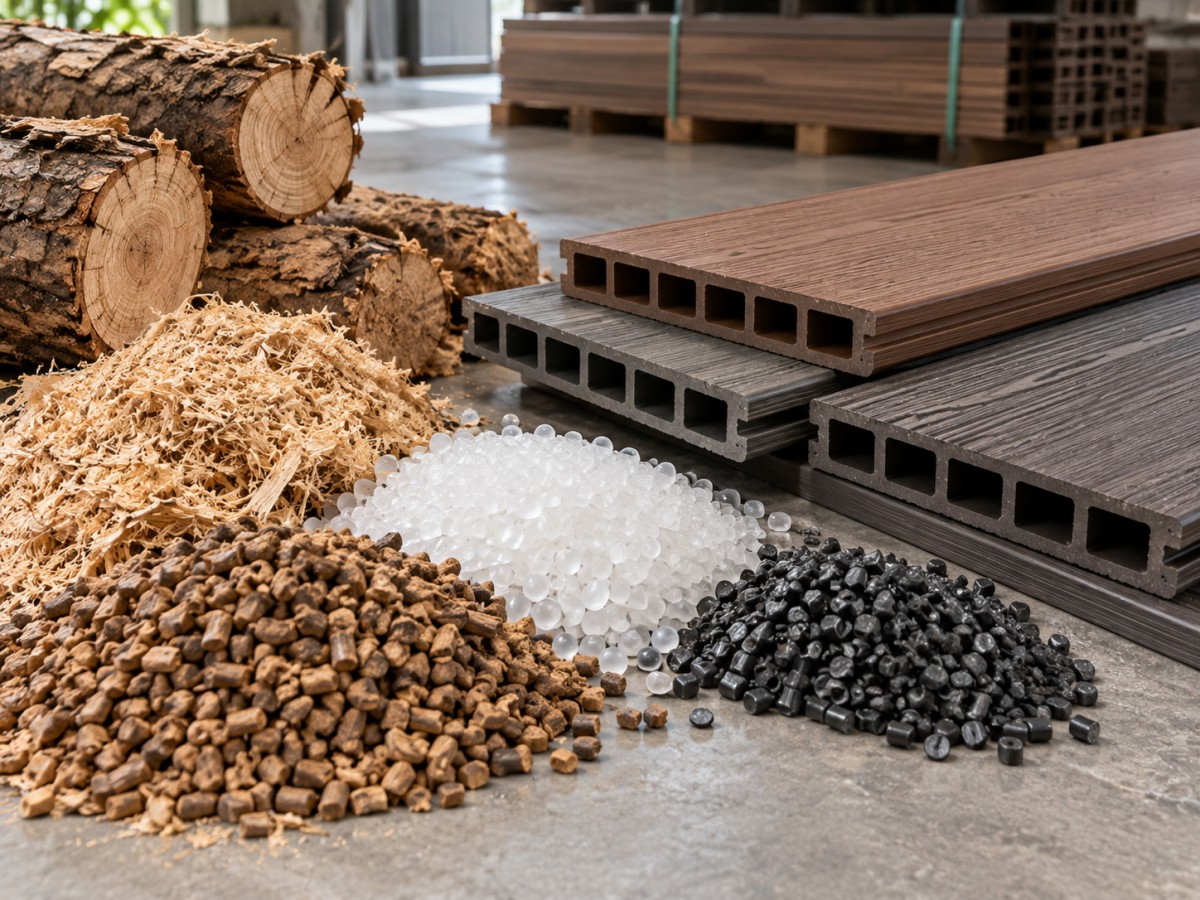
WPC composite decking combines characteristics of wood-derived material with those of manufactured polymers. Its behaviour should therefore be understood as a composite material rather than treated as either conventional plastic or natural timber.
Several characteristics are particularly relevant to outdoor use.
Manufactured Consistency
WPC boards are produced to controlled dimensions and profiles. This generally provides greater consistency in board size and appearance than natural timber.
Manufacturing can also provide repeatable colours and textures across a product range.
Minor variations may still occur between production batches or as a result of outdoor exposure, so complete visual uniformity should not automatically be assumed.
Moisture Behaviour
WPC does not respond to moisture in exactly the same way as solid timber. The polymer component changes how the material interacts with water, while the wood-derived portion means moisture behaviour can still be relevant.
The extent depends on the formulation and board construction.
For this reason, outdoor WPC still requires effective drainage. Describing a composite board as moisture-resistant does not mean the complete deck should be allowed to remain in standing water.
Thermal Movement
Composite boards can expand and contract as temperatures change. Thermal movement is therefore an important installation consideration.
Malaysia's strong sunlight can produce significant differences between shaded and exposed surface temperatures. Appropriate board spacing and fixing methods need to accommodate the expected movement of the selected product.
Manufacturer-specific installation guidance is particularly important because thermal characteristics differ between formulations.
Surface Appearance
WPC surfaces can be produced with different colours, grain patterns and textures. The resulting appearance is generally more controlled than the random grain of natural timber.
Some products aim for a wood-like appearance, while others use a clearly manufactured contemporary finish.
Product samples are useful for assessing texture and colour, but outdoor lighting should be considered because a board may look different in direct sunlight than indoors.
WPC Decking for Malaysia's Climate
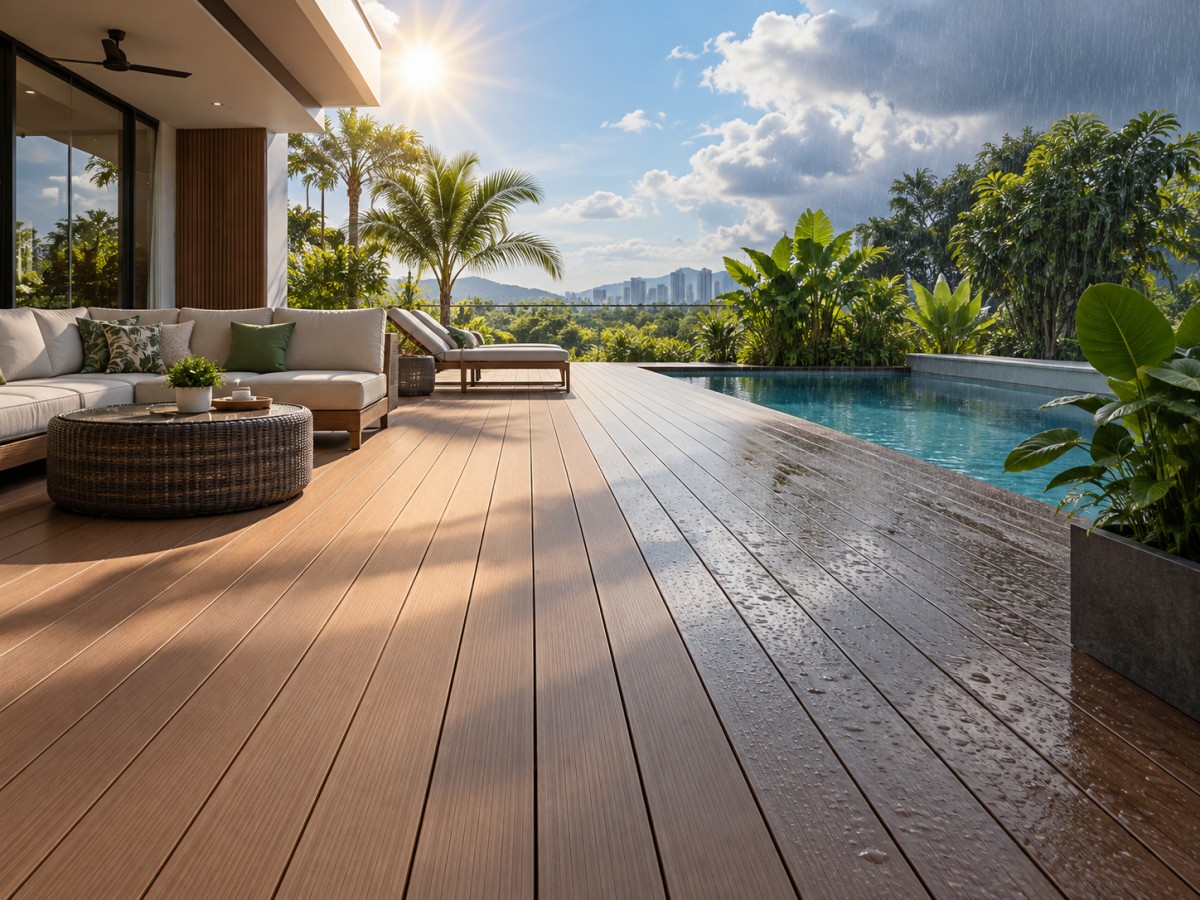
WPC decking can be used in Malaysia when the selected product and complete decking system are suitable for tropical outdoor conditions. Consider rainfall, humidity, UV exposure, heat, and drainage when specifying.
Composite decking is definitely affected by the environment; its response simply differs from natural timber.
Frequent Rainfall
Malaysia receives substantial rainfall, so outdoor decks can become wet repeatedly. WPC boards should be installed in a way that allows surface and sub-deck water to drain.
Board gaps should remain clear enough for water to pass through. Drain outlets underneath the deck should also remain accessible where maintenance is required.
Water trapped beneath composite decking can affect surrounding structures and encourage organic surface growth even if the board itself has good moisture resistance.
High Humidity
High relative humidity is a normal part of Malaysia's tropical environment. WPC does not experience moisture-related movement in exactly the same manner as solid timber, but environmental moisture remains relevant to the overall decking system.
Shaded locations may dry slowly after rain or cleaning.
Good airflow and clear drainage help manage these conditions regardless of the surface material.
Strong Sunlight and UV Exposure
Outdoor composite boards can receive prolonged UV exposure, particularly on uncovered balconies, terraces and rooftop spaces.
Manufacturers may use pigments, additives or surface layers intended to manage outdoor exposure. The effectiveness and long-term behaviour depend on the specific product.
Some change in appearance can occur over time. Product information should be reviewed rather than assuming that every WPC colour will remain completely unchanged.
Surface Temperature
Decking exposed to direct tropical sunlight can become warm. The actual surface temperature depends on factors such as board colour, material composition, airflow, shade and surrounding conditions.
Darker surfaces generally absorb more solar energy than lighter ones, although product-specific behaviour varies.
Surface temperature deserves particular consideration for pool surrounds, balconies and residential spaces where users may walk barefoot.
Shaded and Damp Areas
Composite decking in shaded areas can still develop surface mould, algae or organic deposits. These conditions are influenced by moisture, dirt and limited drying rather than simply the decking material.
Routine cleaning and airflow are therefore necessary.
Persistent growth can indicate that the location remains damp for extended periods or that surrounding drainage requires attention.
WPC Board Types and Construction
WPC decking boards are available in different constructions, and these differences can affect weight, support requirements and installation. The appropriate board type depends on the product system and application.
Two common structural descriptions are solid and hollow boards.
Solid WPC Boards
Solid composite boards have a more continuous internal cross-section. Their construction can provide a substantial board profile.
The actual structural capacity depends on board dimensions, formulation and manufacturer specifications.
A solid profile should not automatically be assumed to require wider support spacing. Joist requirements should always follow the specifications for the actual product.
Hollow WPC Boards
Hollow boards contain internal cavities that reduce the amount of material used in the profile. Their geometry is engineered to provide the required shape and performance for the intended application.
The ends of hollow boards may require particular finishing or detailing depending on the system.
Water management around open board ends should also follow the product's installation requirements.
Capped Composite Boards
Capped WPC incorporates an outer surface layer around part or all of the composite core. This layer is designed to provide particular surface characteristics.
Depending on the product, the cap may influence stain resistance, colour retention or texture.
Capped and uncapped products should not be treated as identical. Cleaning and care instructions can differ according to the surface construction.
Appearance and Design Options
WPC decking provides a manufactured range of colours, textures and board profiles. This allows designers and property owners to select a more consistent visual treatment than is normally possible with natural timber.
Appearance should still be evaluated in the context of the complete outdoor space.
Colour Options
Composite decking can be manufactured in brown, grey and other tones intended to coordinate with different architectural finishes.
Colour choice affects more than appearance. Darker boards may respond differently to direct solar exposure than lighter surfaces.
The surrounding walls, doors, landscaping and furniture should also be considered because decking normally forms a large visual area.
Wood-Grain Textures
Many WPC boards use embossed or textured surfaces intended to resemble timber grain.
These patterns can create a wood-influenced appearance without reproducing the natural variation of solid timber.
Repeated manufactured patterns may be visible depending on the product, so board arrangement can influence the finished appearance.
Board Width and Profile
Board dimensions affect the scale of the finished deck. Wider or narrower profiles create different visual proportions.
The selected board should also be compatible with the substructure and fastening system.
A profile should therefore be chosen for both design and technical reasons.
Laying Direction
The direction of the boards can influence how large or narrow an outdoor space appears.
Straight layouts are common because they are practical and visually controlled. More complex patterns may be possible but can increase cutting, substructure and finishing requirements.
Board direction should ultimately follow the requirements of the supporting structure and chosen product.
WPC Decking Installation and Substructure
WPC decking installation requires a stable supporting structure, appropriate joist spacing, correct board gaps and a fixing system compatible with the selected composite boards. The installation should follow product-specific requirements because composite systems are not universally interchangeable.
The substructure remains one of the most important parts of the deck.
Site Preparation
The installation area should be assessed for levels, drainage, available height and existing structural conditions.
Concrete balconies, landscaped areas, patios and rooftop spaces each present different constraints.
Existing drainage problems should be resolved rather than concealed beneath the new decking.
Substructure Requirements
The substructure supports the WPC boards and transfers loads to the base. Its materials and arrangement need to be suitable for outdoor exposure and compatible with the decking system.
Joist spacing should follow the requirements for the specific board.
Excessive spacing can allow unwanted deflection, while unsuitable support arrangements can affect fastening and overall stability.
Board Spacing
WPC boards require appropriate gaps both for drainage and material movement.
Spacing requirements can apply between adjacent boards and at board ends. Allowance may also be needed where decking meets walls or fixed structures.
The correct dimensions depend on the product, board length and expected environmental conditions.
Concealed Fastening Systems
Many composite decking systems use clips fitted into grooves along the sides of the boards. These concealed fasteners reduce the number of visible screws on the finished surface.
The clips can also help maintain consistent gaps where they are designed as part of the system.
Only compatible fixing components should be used. A generic clip may not provide the same fit or movement allowance as the system specified for the board.
Edge and End Finishing
Exposed deck edges can be finished using fascia boards, trim pieces or other product-specific details.
Finishing should not obstruct required drainage or ventilation.
Hollow profiles may require particular attention to board ends to create an appropriate finished appearance.
Drainage and Ventilation for Composite Decking
Drainage and ventilation are necessary because WPC decking forms part of a larger outdoor construction system. Moisture management remains important even when the decking boards themselves are engineered for exterior use.
Water should be able to leave both the deck surface and the underlying area.
Important principles include:
These principles are particularly relevant in Malaysia because heavy rain can introduce substantial amounts of water in a short period.
A decking system should work with the site's drainage rather than obstruct it.
Cleaning and Maintenance of WPC Decking
WPC decking requires routine cleaning and inspection even though it generally does not require the same refinishing process as natural timber. Maintenance focuses primarily on removing dirt, controlling organic deposits and addressing spills appropriately.
Cleaning frequency depends on location and exposure.
Routine Cleaning
Loose leaves, soil and debris should be removed before they accumulate. This is particularly important around board gaps and drainage points.
General cleaning can then address surface dirt using methods appropriate for the product.
Aggressive abrasive tools should not automatically be used because they may affect textured or capped surfaces.
Managing Spills
Food, oils and other substances should be cleaned before they remain on the surface for extended periods.
The appropriate cleaning method depends on the board's surface construction and manufacturer recommendations.
Testing unfamiliar cleaning products on a less visible area can help reduce the risk of unwanted surface changes.
Mould and Algae
Mould or algae can form on environmental deposits present on the deck, particularly in shaded and damp conditions.
Cleaning the surface and improving moisture management can help control recurrence.
Persistent problems should prompt inspection of drainage, airflow and surrounding vegetation.
Periodic Inspection
Composite decks should be inspected for board condition, movement, loose components, drainage obstruction and changes in the supporting structure.
Inspection is especially useful after unusual weather or where the deck receives intensive use.
WPC may reduce certain timber-specific maintenance tasks, but the complete deck still benefits from regular observation.
Durability and Long-Term Use
WPC decking durability depends on formulation, manufacturing quality, board profile, installation, environmental exposure and maintenance. The word "composite" alone does not establish how long a specific deck will remain serviceable.
The material should therefore be evaluated as part of a complete system.
Product Formulation
The ratio and type of wood material, polymer and additives can influence composite characteristics.
Because formulations are proprietary and vary between manufacturers, direct comparisons should rely on relevant product information where available.
Two boards with a similar appearance can have different internal construction.
Manufacturing Quality
Controlled manufacturing is important for consistency in dimensions, density and surface finish.
Product specifications and appropriate quality information can therefore be useful when comparing options.
Visible appearance alone cannot reveal every material characteristic.
Installation Quality
Correct support spacing, board gaps and fixing methods are important to long-term performance.
Composite boards installed without sufficient allowance for thermal movement may experience avoidable stress.
Installation should therefore follow the requirements of the specific system.
Environmental Exposure
Fully exposed decks experience different conditions from sheltered installations.
UV exposure, surface heat, rainfall, shade and surrounding vegetation can all influence the deck over time.
Expected exposure should be established before the product is selected.
WPC Decking and Natural Timber: Key Material Differences
WPC and natural timber are distinct material systems with different characteristics. WPC should not be described simply as artificial timber because its composition and environmental behaviour differ from solid wood.
The following comparison highlights the principal distinctions.
| Characteristic | WPC Composite Decking | Natural Timber Decking |
|---|---|---|
| Material | Wood-derived material and polymer composite | Solid natural wood |
| Board appearance | Manufactured and relatively consistent | Naturally varied |
| Grain | Embossed or manufactured texture | Genuine natural grain |
| Moisture behaviour | Product-specific composite response | Natural moisture absorption and release |
| Thermal movement | Important installation consideration | Movement influenced strongly by moisture |
| Refinishing | Generally not timber-style refinishing | Can accept suitable timber treatments |
| Routine cleaning | Required | Required |
| Colour change | Product and exposure dependent | Natural weathering occurs |
| Board dimensions | Manufactured consistency | Natural material variation |
Neither category is universally preferable. The appropriate choice depends on the intended outdoor environment and the characteristics valued by the property owner.
Common Outdoor Applications for WPC Decking
WPC composite decking can be used in various residential, landscape and commercial outdoor spaces when the selected system is appropriate for the site.
Each application creates different environmental and usage conditions.
Balconies and Condominium Outdoor Areas
WPC can provide a consistent outdoor flooring surface for balconies where available height, drainage and building conditions permit decking installation.
Its manufactured profile can be useful where visual consistency is preferred.
Existing balcony drains and thresholds should remain part of the planning process.
Patios and Terraces
Residential patios and terraces can use composite boards to define seating, dining and circulation areas.
Both sheltered and exposed terraces are possible applications, although the degree of sunlight and rainfall should influence product selection.
Furniture placement should allow cleaning and drainage access.
Garden Decks
WPC can be used to form outdoor living areas within gardens and landscaped spaces.
The substructure should be appropriately separated from unsuitable ground conditions, while vegetation should not obstruct airflow or drainage.
Leaves and organic debris require regular removal even when composite boards are used.
Poolside Areas
Composite decking may be considered around pools where the specific product is suitable for the intended environment.
Surface characteristics, heat exposure and water drainage deserve particular attention in areas where users may be barefoot.
The selected board should be assessed according to actual product information rather than assuming every WPC product is appropriate for poolside use.
Commercial Outdoor Spaces
Restaurants, hospitality properties and other commercial spaces may use WPC where a consistent manufactured appearance and defined maintenance process are desired.
Traffic, cleaning frequency and operational requirements need to be considered.
Commercial installations may also have project-specific structural or regulatory requirements beyond the decking material itself.
How to Choose WPC Decking
Choosing WPC decking requires comparing the actual product specifications with the conditions of the installation area. Colour and texture are useful design considerations, but they should not be the only selection criteria.
A structured assessment can make product comparison clearer.
Identify the Outdoor Environment
Determine whether the space is fully exposed, partly sheltered or predominantly covered.
Consider rainfall, shade, sunlight, ventilation and surrounding vegetation.
These conditions influence both material behaviour and cleaning requirements.
Review the Board Construction
Establish whether the product is solid, hollow, capped or uncapped.
Board construction can influence weight, surface characteristics, finishing and installation requirements.
The profile should be suitable for the proposed application.
Check Support Requirements
Review the specified joist spacing and substructure requirements.
This is particularly important where installation height is limited or an existing structure will be used.
The support system should be planned around the actual board rather than assumed from another composite product.
Consider Thermal Movement
Confirm the required gaps at board sides, ends and fixed structures.
Malaysia's outdoor temperatures make thermal movement an important consideration for composite decking.
Long board runs may require particular attention according to product specifications.
Evaluate Surface Characteristics
Consider texture, colour, pattern and how the surface may behave when exposed to sunlight or water.
For barefoot areas, surface temperature and walking characteristics deserve additional attention.
Samples can help establish expectations before installation.
Understand Cleaning Requirements
Check the recommended cleaning methods and any limitations on chemicals or equipment.
This is especially important for capped or specially textured boards.
Maintenance instructions should be practical for the way the outdoor space will be used.
Common Misunderstandings About WPC Decking
Several assumptions about composite decking can lead to unrealistic expectations. Understanding what WPC can and cannot do supports more accurate material selection.
WPC Is Maintenance-Free
WPC generally reduces the need for timber-specific refinishing, but it is not maintenance-free.
Outdoor surfaces still collect dust, leaves, organic material and spills. Routine cleaning and inspection remain necessary.
WPC Does Not Expand or Contract
Composite boards can move as temperature changes.
Correct expansion gaps and fixing systems are therefore important. Ignoring thermal movement can create installation problems.
WPC Is Completely Waterproof
WPC can have good resistance to moisture, but "waterproof" is an oversimplification of the complete decking system.
Water still needs to drain from the surface and underlying structure. Persistent standing water should not be treated as acceptable simply because the visible boards are composite.
All Composite Decking Is Identical
WPC formulations, profiles and surfaces vary between manufacturers.
A product should be evaluated using its own specifications rather than general assumptions about the category.
WPC Never Changes Colour
Outdoor exposure can influence the appearance of composite decking.
The extent depends on pigments, surface construction, formulation and UV exposure. Product-specific information provides a more reliable indication than a universal claim.
Frequently Asked Questions (FAQs)
What does WPC decking mean?
WPC stands for wood-plastic composite. WPC decking is manufactured from wood-derived material combined with thermoplastic polymers and other formulation components to produce boards for outdoor flooring applications.
Is WPC decking suitable for Malaysia?
WPC can be suitable for Malaysian outdoor spaces when the specific product is intended for the relevant conditions and is correctly installed. Rainfall, UV exposure, heat, drainage and ventilation should all be considered during selection.
Does WPC decking contain real wood?
WPC normally contains a wood-derived component such as wood fibres or wood flour. It is combined with polymer and other components, so the finished board is a composite rather than solid natural wood.
Does WPC decking require maintenance?
Yes. WPC requires routine cleaning, debris removal and inspection. It generally does not require the same surface refinishing process as natural timber, but this does not eliminate normal outdoor maintenance.
Can WPC decking fade in sunlight?
The appearance of WPC can change under prolonged outdoor exposure. The extent depends on the product formulation, pigments, surface construction and UV conditions. Product-specific information should be reviewed when colour retention is important.
Does WPC expand in hot weather?
Composite decking can expand and contract as temperature changes. Correct spacing and fastening allow for expected thermal movement, making product-specific installation requirements important in Malaysia's warm climate.
Can WPC decking be used around a swimming pool?
WPC may be used in poolside environments when the specific product is suitable for that application. Surface characteristics, drainage and heat exposure should be evaluated because pool areas are frequently wet and may be used barefoot.
Is hollow or solid WPC better?
Neither construction is automatically better for every project. Solid and hollow boards have different profiles, weights and system requirements. Selection should be based on the product specifications and intended application.
Does WPC need a substructure?
Yes. WPC decking boards require an appropriate supporting structure. Joist spacing, material compatibility and fixing requirements depend on the specific decking system.
Is WPC the same as PVC decking?
No. WPC contains wood-derived material combined with polymer, while PVC decking is primarily based on polyvinyl chloride rather than a wood-plastic composite formulation. Their material behaviour and product specifications can therefore differ.
Understanding WPC as a Complete Outdoor System
WPC composite decking provides a manufactured outdoor flooring option that combines wood-derived material with polymers. Its consistent profiles, range of surface finishes and reduced need for timber-specific refinishing make it distinct from natural hardwood decking.
For Malaysian conditions, product selection should account for more than the visible board. Frequent rain requires effective drainage, strong sunlight makes UV exposure and surface temperature relevant, and warm conditions make thermal movement an important installation consideration.
WPC products also differ considerably. Board construction, formulation, surface treatment and fixing systems should therefore be reviewed at product level rather than assuming that all composite decking performs identically.
A well-planned WPC deck combines an appropriate board with a compatible substructure, correct spacing, effective drainage and realistic maintenance. Treating these components as one system provides a more reliable basis for long-term outdoor use.