
Chengal, Merbau and Balau are tropical hardwood options that can be considered for outdoor decking, but they differ in botanical identity, appearance, timber characteristics and sourcing. When comparing Chengal vs Merbau vs Balau, there is no single timber that is automatically suitable for every outdoor deck.
Chengal is a Malaysian hardwood botanically identified as Neobalanocarpus heimii. Merbau refers to timber from the Intsia genus, while Balau is a commercial timber grouping commonly associated with several Shorea species.
These distinctions matter because the species name is only one part of decking performance. Board quality, heartwood content, site exposure, drainage, ventilation, substructure, fastening and maintenance can significantly influence how natural timber behaves outdoors.
Malaysia's frequent rainfall, high humidity and strong sunlight make this particularly important. The most suitable hardwood should therefore be selected by matching its material characteristics with the actual decking environment rather than choosing solely by appearance or reputation.
Chengal, Merbau and Balau Compared
Chengal, Merbau and Balau are all natural tropical hardwood materials, but they should not be treated as interchangeable. Each has its own visual and material characteristics.
A high-level comparison helps establish the main distinctions.
| Consideration | Chengal | Merbau | Balau |
|---|---|---|---|
| Timber identity | Neobalanocarpus heimii | Intsia species | Commercial group associated with Shorea species |
| Geographic association | Native to Peninsular Malaysia | Southeast Asia and wider Asia-Pacific | Southeast Asia |
| Timber type | Dense tropical hardwood | Dense tropical hardwood | Generally dense tropical hardwood |
| Appearance | Warm natural hardwood tones | Commonly brown to reddish-brown | Varies according to supplied timber |
| Natural grain | Yes | Yes | Yes |
| Colour variation | Expected | Expected | Expected |
| Exterior applications | Suitable applications | Suitable applications | Suitable applications |
| Natural weathering | Expected | Expected | Expected |
| Routine maintenance | Required | Required | Required |
| Drainage and ventilation | Essential | Essential | Essential |
This comparison provides general context rather than a universal ranking. The actual boards and decking system should still be assessed for every project.
What Is Chengal Timber?
Chengal is a dense tropical hardwood native to Peninsular Malaysia. Its botanical name is Neobalanocarpus heimii, and it belongs to the Dipterocarpaceae family.
Chengal has historically been associated with demanding timber applications because of the natural durability characteristics of its heartwood.
For outdoor decking, its density, natural grain and exterior timber characteristics make it relevant where genuine Malaysian hardwood is preferred.
Chengal remains a natural material. It responds to moisture, sunlight and weather, so correct construction is still necessary.
What Is Merbau Timber?
Merbau is a tropical hardwood associated with trees from the Intsia genus. It occurs across parts of Southeast Asia and the wider Asia-Pacific region.
Merbau is generally dense and is recognised for its warm brown to reddish-brown appearance.
For decking, its natural grain and hardwood characteristics can suit appropriate exterior applications.
Merbau can also contain natural extractives that may produce coloured runoff when the timber becomes wet, particularly during earlier periods of outdoor exposure. This should be considered where deck runoff could reach light-coloured adjacent finishes.
What Is Balau Timber?
Balau is a commercial timber name commonly associated with several hardwood species from the Shorea genus. It should therefore not be interpreted as one single botanical species.
The characteristics of Balau can vary according to the actual timber supplied.
Balau is generally associated with dense tropical hardwood used in exterior and structural applications.
For decking projects, buyers should therefore confirm the timber specifications rather than relying only on the Balau commercial name.
Appearance and Timber Characteristics
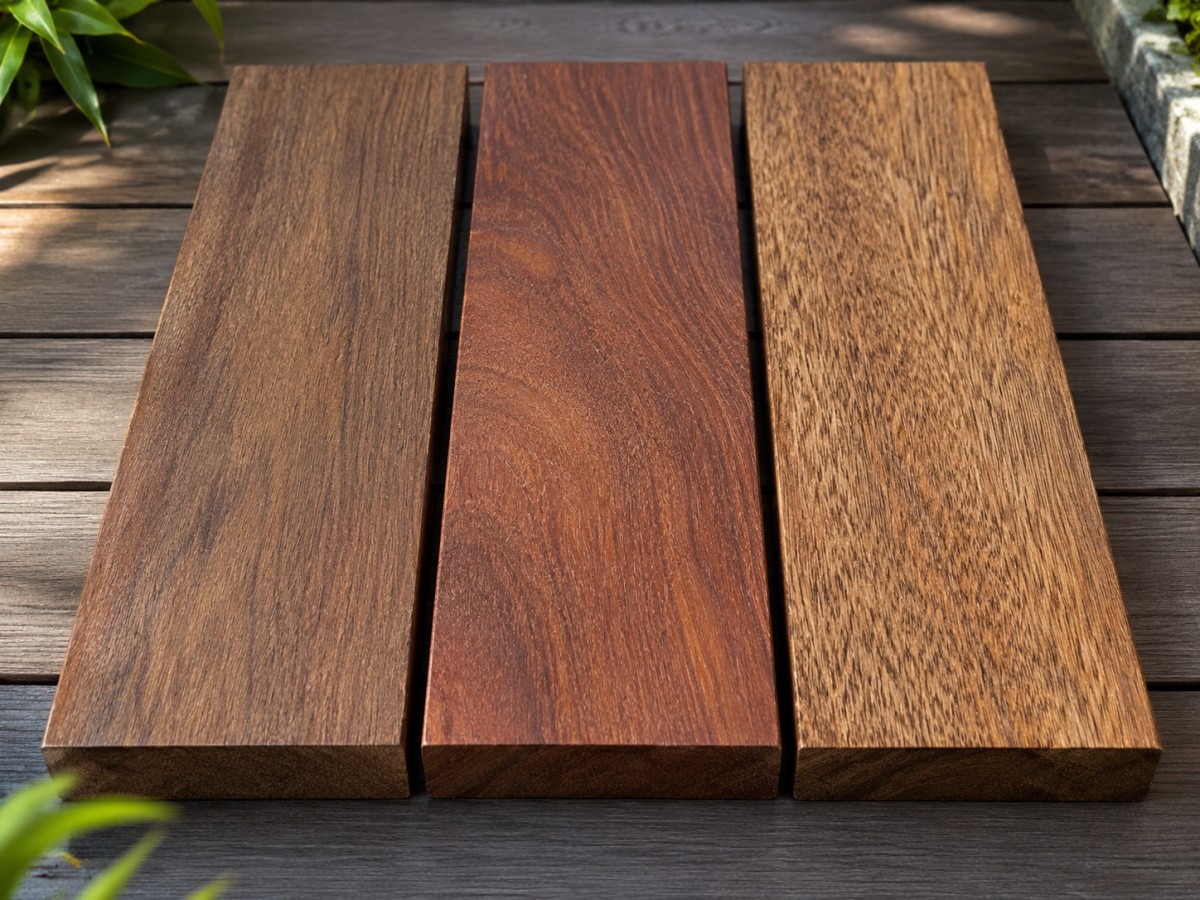
Chengal, Merbau and Balau all provide genuine natural wood surfaces, but their colours, grain patterns and overall visual character differ. Appearance can therefore be a useful selection factor when technical requirements are also satisfied.
Natural timber should not be expected to provide the uniformity of a manufactured decking product.
Individual boards can vary within the same species.
Chengal Appearance
Chengal typically provides warm natural hardwood tones and visible grain variation.
Its appearance can suit contemporary, tropical and landscape-oriented outdoor designs.
Individual boards can differ in colour and grain.
Outdoor exposure gradually changes the surface, particularly where the deck receives strong UV radiation.
Chengal should therefore be selected with the expectation that its appearance will evolve rather than remain identical to freshly installed timber.
Merbau Appearance
Merbau commonly presents brown to reddish-brown tones that can create a warm hardwood surface.
Natural variation occurs between boards.
Merbau's colour can also change under outdoor exposure.
Sections beneath furniture or architectural shade may weather differently from fully exposed boards.
Its natural extractives are another material characteristic to consider because coloured runoff may affect adjacent pale surfaces in some installations.
Balau Appearance
Balau's appearance can vary because the commercial name covers more than one timber species.
Natural brown, golden-brown and deeper hardwood tones may occur depending on the actual material supplied.
Grain and colour variation should be expected.
For projects where a particular appearance is important, reviewing the actual supplied boards is more useful than relying on a generic Balau sample.
Natural Variation Across All Three Timbers
Chengal, Merbau and Balau all contain natural variation because they are solid wood materials. No two boards should be expected to have exactly the same grain and colour.
This variation is not necessarily a defect.
Board arrangement can help distribute differences across the finished deck.
A small sample should therefore be used to understand the general character of the timber rather than as a promise that every installed board will match it exactly.
Density and Material Behaviour
All three timber options are generally associated with dense hardwood characteristics, but density should not be treated as the only measure of decking suitability. Dense timber still responds to environmental moisture and requires correct installation.
Density influences machining and fastening.
Appropriate cutting equipment and fixing methods should be used.
Pre-drilling may be suitable for screw-fixed dense hardwood decking to create controlled fixing positions and reduce unnecessary stress around board edges.
Heartwood, Sapwood and Board Quality
Heartwood, sapwood and overall board quality can influence exterior timber performance. This is relevant to Chengal, Merbau and Balau.
Heartwood is the older inner portion of a tree.
Sapwood is the younger outer tissue involved in transporting water while the tree grows.
The durability commonly associated with a timber species or group should not automatically be assumed to apply equally to every section of every board.
Clear material specifications therefore remain important regardless of which hardwood is selected.
Durability and Outdoor Performance
Chengal, Merbau and Balau can all be relevant to exterior applications, but outdoor durability depends on both timber characteristics and the environment surrounding the deck.
No hardwood should be treated as immune to poor drainage or unsuitable construction.
Persistent moisture, inadequate support or restricted ventilation can create unfavourable conditions around any timber.
The appropriate comparison should therefore include the complete decking system.
Chengal Durability Characteristics
Chengal heartwood is recognised for natural durability, which is one reason the timber has historically been used for demanding applications.
This characteristic can be valuable for exterior decking.
It does not remove the need for drainage, ventilation or maintenance.
A Chengal board installed over persistent standing water can still be exposed to unnecessarily harsh conditions.
Natural durability works best when the surrounding construction also manages moisture appropriately.
Merbau Durability Characteristics
Merbau has natural characteristics that make it relevant for suitable outdoor timber applications.
Its dense hardwood structure contributes to its use in decking and other exterior applications.
Performance still depends on board quality and installation.
Effective drainage and suitable board spacing are necessary because Merbau remains natural wood that responds to moisture.
The timber should therefore be evaluated as part of a complete outdoor system rather than independently.
Balau Durability Characteristics
Balau is generally associated with dense hardwood characteristics suitable for appropriate exterior applications. However, the exact material matters because Balau covers several Shorea species.
The supplied timber should therefore be identified and assessed.
Installation quality remains equally important.
A high-quality Balau board cannot correct a substructure that prevents drainage or provides inadequate support.
Which Timber Handles Malaysia's Climate Better?
Chengal, Merbau and Balau can all be used in suitable Malaysian outdoor environments when the material and decking system are appropriate. Climate suitability cannot be determined from species name alone.
Malaysia creates several recurring environmental challenges:
The decking system should address these conditions regardless of which hardwood is selected.
Rainfall and Moisture Exposure
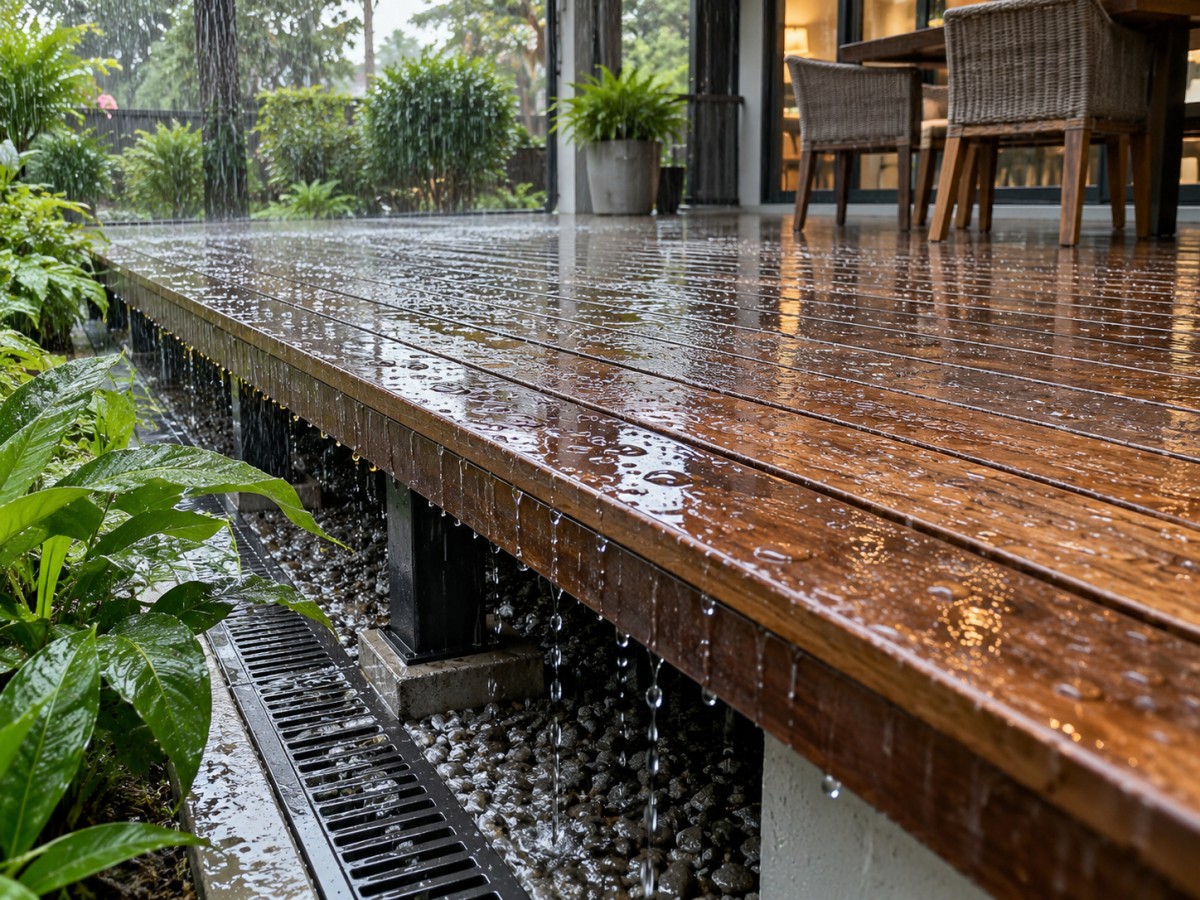
Rainfall affects all three timber options because exterior decking naturally becomes wet. The important factor is whether the deck allows water to leave efficiently.
Board gaps allow rainwater to pass through the surface.
The area beneath should then direct water towards suitable drainage.
The substructure should not create unnecessary barriers that trap water.
Chengal, Merbau and Balau all benefit from this moisture-management approach.
Humidity and Drying Conditions
High humidity can slow the drying of outdoor timber after rainfall. Shaded decks may remain damp longer than open areas exposed to airflow and sunlight.
All three hardwoods naturally exchange moisture with the environment.
This can cause dimensional movement.
Suitable board spacing helps accommodate these changes.
Ventilation beneath the deck also supports drying, particularly in low-clearance or enclosed installations.
UV Exposure and Colour Change
Sunlight gradually changes the surface colour of Chengal, Merbau and Balau. None should be expected to retain its freshly installed colour indefinitely without appearance-focused maintenance.
The degree of exposure matters.
An open pool deck may weather more quickly than a covered balcony.
Furniture and planters can also create uneven weathering because they shield certain areas from sunlight.
Colour change should therefore be anticipated when selecting any natural hardwood.
Natural Timber Movement
Natural timber expands and contracts as its moisture condition changes. Chengal, Merbau and Balau all need installation systems that accommodate this behaviour.
Correct board spacing is essential.
Fasteners should securely support the boards without assuming the timber will remain dimensionally static.
The actual board condition during installation can also influence spacing decisions.
Natural movement should be planned for rather than treated as something that can be completely eliminated.
Maintenance Requirements
Chengal, Merbau and Balau all require routine maintenance because every outdoor decking surface is exposed to dirt, moisture and environmental debris. The required maintenance is not limited to applying surface finishes.
Routine care focuses primarily on cleanliness, drainage and physical inspection.
Appearance treatments are optional depending on the desired visual result.
Cleaning Requirements
All three hardwoods should be cleaned to remove leaves, soil and other debris.
Organic material can retain moisture.
Board gaps should therefore remain reasonably clear.
The cleaning frequency depends more on the environment than the timber species.
A garden deck beneath trees may require more frequent attention than a relatively sheltered balcony regardless of whether the surface is Chengal, Merbau or Balau.
Mould and Algae
Mould and algae can develop on any of the three timber surfaces where moisture, shade and organic material create favourable conditions.
This is not automatically evidence that the hardwood itself has failed.
Recurring growth may indicate poor drainage, blocked board gaps or limited airflow.
Cleaning the visible surface is useful, but correcting persistent damp conditions can be equally important.
The surrounding environment should therefore be assessed when mould or algae repeatedly returns.
Surface Treatments
Surface treatments may be used on Chengal, Merbau or Balau when the owner wants to influence the timber's appearance.
The appropriate treatment depends on the timber condition and existing finish.
Surface treatments should not be treated as substitutes for proper drainage.
A deck should first be physically sound, clean and capable of drying.
Owners who accept natural weathering may choose less appearance-focused maintenance while continuing routine inspection and cleaning.
Which Timber Requires the Least Maintenance?
No responsible comparison can determine maintenance requirements from the timber name alone. Site exposure and the owner's appearance expectations have a substantial influence.
A fully exposed Chengal deck that is maintained to preserve a particular colour may require more appearance-focused attention than a naturally weathered Merbau deck.
A shaded Balau garden deck may require frequent debris and algae cleaning because of its environment.
Maintenance should therefore be evaluated according to the complete project rather than assuming one hardwood is maintenance-free.
Installation Considerations
Chengal, Merbau and Balau are dense natural hardwoods, so installation quality is critical for all three. The supporting system needs to account for drainage, board movement and outdoor exposure.
The main installation principles are similar even though exact specifications vary.
Substructure
The substructure supports the decking boards and distributes loads to the underlying surface or structure.
Joist spacing should suit the board dimensions and intended application.
Supporting components should also be suitable for exterior conditions.
The framework should allow water to move beneath the deck instead of unnecessarily obstructing drainage.
The substructure therefore influences long-term performance regardless of the hardwood selected.
Board Spacing
Board spacing provides room for natural timber movement and allows rainwater to pass through the decking surface.
The correct gap depends on the actual boards and installation conditions.
Chengal, Merbau and Balau should not simply be installed with identical gaps without considering their dimensions and condition.
Spacing decisions should be made according to the material and site.
Fastening
Dense hardwood generally requires appropriate outdoor fasteners and installation methods.
Pre-drilling may be appropriate for screw-fixed boards.
Fastener suitability should also reflect environmental exposure.
Poolside or coastal locations may create different requirements from sheltered residential areas.
Both visible and compatible concealed fastening systems may be considered depending on the board profile and decking design.
Concealed Decking Systems
Concealed fastening can reduce visible screw heads across a natural timber deck. The system should be compatible with the selected Chengal, Merbau or Balau board.
Hidden fixing does not eliminate timber movement.
Spacing, drainage, ventilation and support remain necessary.
Future board access should also be considered.
A concealed system should therefore be selected as part of the complete construction rather than solely for appearance.
Typical Outdoor Applications
Chengal, Merbau and Balau can all be considered for suitable outdoor decking applications, but the best fit depends on site conditions and project requirements.
The application itself should be assessed before choosing the timber.
Balconies
Natural hardwood can be used on suitable balconies where installation height, drainage and building requirements permit.
Existing floor drains should remain functional.
Balconies can receive direct sun and wind-driven rain even when partially covered.
The final choice between Chengal, Merbau and Balau should therefore consider the actual board specifications and desired appearance.
Patios and Terraces
All three timbers can be relevant to suitable patio and terrace applications.
The amount of exposure should be assessed.
An open terrace receives more direct rainfall and UV than a covered patio.
Furniture, dining use and cleaning access should also be considered when planning the board layout.
Garden Decks
Natural hardwood works visually with landscaped garden environments.
Chengal, Merbau and Balau can all provide genuine wood grain alongside vegetation and other natural materials.
Garden decks require careful management of leaves, soil and moisture.
The timber choice should therefore be combined with appropriate ground preparation, drainage and maintenance access.
Poolside Decking
Suitable hardwood can be considered around pools when the decking system addresses frequent wetting, sunlight, drainage and barefoot use.
Board and fastener conditions should be inspected regularly.
The surface should also be maintained so environmental deposits do not create unnecessary issues.
Poolside suitability should be assessed for the specific project rather than determined only from the timber species.
Commercial and Hospitality Spaces
Chengal, Merbau and Balau may be considered suitable restaurants, hotels, resorts and landscaped commercial environments.
Commercial use generally increases traffic and cleaning requirements.
Furniture movement and operational access should also be considered.
The timber should be selected together with a maintenance programme appropriate for the property.
Cost and Selection Factors
The overall requirements for Chengal, Merbau and Balau depend on the actual timber specification, board dimensions, sourcing, site conditions and installation system. A meaningful comparison should therefore consider the complete decking project rather than a generic material price.
Natural timber availability can also change.
The same commercial timber name may be offered in different board sizes, grades or specifications.
Installation requirements can further influence the overall project because substructure, site preparation, fastening and design complexity vary between properties.
Long-term maintenance should also be considered. A material that aligns with the owner's preferred appearance and maintenance approach can be more practical than choosing timber solely according to the initial material requirement.
Responsible Timber Sourcing
Responsible sourcing is an important consideration when selecting natural tropical hardwood. Chengal, Merbau and Balau should be evaluated not only for appearance and physical characteristics but also for the transparency of their supply.
Buyers should ask suppliers to identify the timber accurately.
Relevant documentation or certification may also help provide information about sourcing where available.
This is particularly important when commercial names cover multiple species, as with Balau.
Clear material identification helps both technical selection and responsible procurement.
Chengal vs Merbau: Key Differences
Chengal vs Merbau is primarily a comparison between two distinct tropical hardwoods with different botanical identities and visual characteristics.
Chengal is Neobalanocarpus heimii and is native to Peninsular Malaysia. Merbau is associated with the Intsia genus and occurs across a wider regional distribution.
Merbau commonly displays brown to reddish-brown tones, while Chengal has its own warm hardwood appearance.
Merbau's natural extractives can also create coloured runoff in some conditions, which should be considered near pale adjacent surfaces.
Both require correct drainage, ventilation and maintenance for outdoor decking.
Merbau vs Balau: Key Differences
Merbau and Balau differ in both timber identity and consistency of commercial classification. Merbau refers to Intsia timber, while Balau is a broader commercial grouping associated with multiple Shorea species.
Balau can therefore show greater variation depending on the specific material supplied.
Merbau has its own characteristic colour and extractive behaviour.
Both are dense tropical hardwood materials relevant to appropriate outdoor applications.
Clear board specifications are important when comparing them for an actual project.
Chengal vs Balau: Key Differences
Chengal and Balau differ because Chengal refers to a specific Malaysian species while Balau is a commercial timber grouping.
This distinction makes timber identification particularly important when Balau is being considered.
Both can provide dense natural hardwood surfaces.
Their appearance, actual material characteristics and availability can differ.
The selection should therefore be based on the specific supplied timber and project requirements rather than treating the names as interchangeable.
How to Choose Between Chengal, Merbau and Balau
Choosing between these three hardwoods requires matching the actual timber with the environment, design and maintenance expectations of the deck. A species comparison should therefore be followed by a project-specific assessment.
A practical selection process can follow these steps:
This process helps ensure the final timber choice reflects the actual outdoor environment.
Common Mistakes When Comparing Hardwood Decking
Comparisons between Chengal, Merbau and Balau can become misleading when one characteristic is treated as the sole measure of quality. Outdoor decking performance is more complex.
Choosing Only by Hardness or Density
Density is relevant but does not describe drainage, timber quality or installation.
A dense hardwood still requires a suitable decking system.
Assuming One Species Never Needs Maintenance
All outdoor timber requires cleaning and inspection.
Appearance-focused maintenance varies according to owner expectations.
Ignoring the Actual Timber Supplied
Commercial names alone do not describe every board characteristic.
This is particularly relevant to Balau because it can refer to multiple Shorea species.
Ignoring Natural Weathering
All three timbers change visually outdoors.
A freshly installed sample should not be treated as the permanent appearance of the deck.
Comparing Timber Without Comparing Installation
A high-quality hardwood installed poorly may perform less effectively than an appropriately selected timber installed within a well-designed system.
Substructure, drainage and fastening should therefore be included in every comparison.
Frequently Asked Questions (FAQs)
Which is better for decking: Chengal, Merbau or Balau?
There is no single choice that is automatically suitable for every deck. Chengal, Merbau and Balau have different material and appearance characteristics, while board quality, site exposure, drainage and installation also influence suitability.
What is the main difference between Chengal and Merbau?
Chengal is Neobalanocarpus heimii, a hardwood native to Peninsular Malaysia, while Merbau is associated with the Intsia genus. They also differ in visual characteristics and other timber properties.
Is Balau one timber species?
No. Balau is a commercial timber grouping commonly associated with several Shorea species. The actual timber supplied should therefore be identified when possible.
Which timber is suitable for Malaysia's rainy climate?
All three can be considered for suitable Malaysian outdoor applications when the material quality and decking system are appropriate. Effective drainage, ventilation and board spacing remain necessary regardless of the timber selected.
Which timber keeps its colour longest?
All natural timber changes under outdoor UV and weather exposure. The rate of colour change depends on the timber, exposure and surface-maintenance approach, so permanent original colour should not be assumed for any of the three.
Do Chengal, Merbau and Balau need maintenance?
Yes. All require routine cleaning and inspection. Surface treatments may also be used when maintaining a particular timber appearance is desired.
Can all three timbers use concealed fasteners?
Compatible concealed fastening systems may be possible depending on the board profile and decking system. Hidden fixing does not remove the need for correct spacing, drainage and support.
Which timber is suitable around swimming pools?
Any of the three may be considered for appropriate poolside applications where the actual timber and complete decking system suit frequent wetting, sunlight, drainage and barefoot use.
Is Chengal always better because it is Malaysian?
Geographic origin alone does not determine suitability for a particular deck. Chengal has relevant natural characteristics, but project requirements, material quality and installation still need to be assessed.
What should I compare before choosing hardwood decking?
Compare the actual timber identification, board quality, appearance, site exposure, drainage, substructure, fastening system, maintenance expectations and sourcing. These factors provide a more complete basis for selection than species name alone.
Choosing Hardwood Based on the Complete Decking System
Chengal, Merbau and Balau each offer the natural grain, variation and material character expected from tropical hardwood decking. Their differences are meaningful, but none should be evaluated independently of the environment where the deck will be installed.
Chengal provides the characteristics of a specific Malaysian hardwood. Merbau offers its own distinctive appearance and material behaviour, while Balau represents a broader group of dense Shorea timbers whose exact specifications should be confirmed.
Malaysia's rainfall, humidity and sunlight affect all three. Effective drainage, ventilation, suitable board spacing and appropriate fastening therefore remain fundamental regardless of which hardwood is selected.
The most appropriate choice comes from matching the actual timber with the site's exposure, intended use, desired appearance and maintenance expectations. This approach provides a more useful basis for outdoor decking selection than attempting to identify one universal winner among Chengal, Merbau and Balau.