
Timber decking and natural stone are both used to create outdoor surfaces, but they differ substantially in material behaviour, construction, surface temperature, drainage and maintenance. The choice between timber decking vs stone should therefore be based on the conditions and intended use of the outdoor space rather than appearance alone.
Timber decking uses natural wood boards installed over a supporting substructure. Natural stone flooring uses materials such as granite, slate, quartzite or other suitable stone products installed according to the requirements of the specific stone and outdoor flooring system.
Malaysia's tropical conditions make these differences particularly important. Frequent rainfall, high humidity and strong sunlight can affect the surface and support construction of both materials.
Wood decking vs stone is therefore not simply a comparison between two natural-looking materials. Each creates a different outdoor flooring system, and the appropriate choice depends on drainage, heat exposure, installation conditions, maintenance expectations and architectural requirements.
Timber Decking and Stone Flooring Compared
Timber decking and stone flooring are both derived primarily from natural materials, but they function differently once installed outdoors. Timber creates a board-based surface that accommodates natural wood movement, while stone generally creates a harder mineral surface over an appropriately prepared supporting system.
The main differences can be summarised as follows.
| Consideration | Timber Decking | Natural Stone Flooring |
|---|---|---|
| Material | Natural wood | Natural mineral material |
| Surface | Individual boards | Stone slabs, pavers or tiles |
| Appearance | Natural grain and colour variation | Natural mineral pattern and tonal variation |
| Construction | Boards over a substructure | Installed over a suitable prepared base or system |
| Water management | Water passes between board gaps | Water generally moves across or through the designed surface system |
| Material movement | Responds to moisture | System must accommodate substrate and thermal movement |
| Weathering | Colour changes naturally | Product-specific ageing and staining |
| Surface treatment | Optional timber finishing | Stone-specific sealing may be used where appropriate |
| Local repair | Individual boards may be replaced | Individual stone pieces may sometimes be replaced |
| Maintenance | Cleaning, inspection and optional refinishing | Cleaning and stone/system-specific maintenance |
These characteristics are general. Individual timber species and stone types can behave differently.
What Is Timber Decking?
Timber decking is an exterior flooring system made from natural wood boards fixed over joists or another appropriate substructure. The boards are normally separated by gaps that accommodate timber movement and allow water to pass through the surface.
Natural timber is hygroscopic, which means it exchanges moisture with the surrounding environment.
Changes in moisture can cause the boards to expand or contract. Proper spacing and fastening help accommodate this normal behaviour.
Suitable tropical hardwoods such as Chengal, Merbau and Balau may be considered for Malaysian outdoor applications where their material characteristics, quality and installation are appropriate.
What Is Natural Stone Flooring?
Natural stone flooring uses pieces of quarried stone that are cut and prepared for use as a finished surface. The characteristics of the flooring depend heavily on the specific stone selected.
Granite, slate, quartzite and other natural stone materials can differ in hardness, porosity, texture and appearance.
Outdoor suitability should therefore be established for the actual stone rather than assuming every natural stone performs identically.
The installation system also matters. Substrate preparation, drainage, joints and any appropriate sealing or treatment can influence long-term performance.
Appearance and Design Options
Timber and stone both provide natural visual variation, but the character of that variation is different. Timber shows organic grain patterns formed during tree growth, while stone shows mineral structures, veining, texture and tonal variation created through geological processes.
Both materials can complement outdoor architecture and landscaping.
Natural Timber Appearance
Timber boards have individual grain, colour and natural variation.
No two boards are completely identical.
The board format also creates directional lines across the deck, which can visually influence the perceived width or length of the outdoor space.
Timber gradually changes colour outdoors, creating a surface that evolves with exposure.
Natural Stone Appearance
Natural stone provides mineral patterns and tonal variation.
Depending on the material, the surface can appear relatively uniform or highly varied.
Stone can complement walls, landscaping, water features and other hardscape elements.
The final appearance also depends on slab or tile size, joint layout and surface finish.
Natural Variation in Timber and Stone
Both timber and stone should be selected with the expectation of natural variation. Neither material should necessarily be expected to match a single small sample exactly across an entire outdoor area.
Timber varies in grain and colour between boards.
Stone can vary in tone, pattern and mineral characteristics between individual pieces.
For both materials, thoughtful selection and layout can distribute variation across the finished surface.
Natural variation should therefore be treated as a material characteristic rather than automatically interpreted as inconsistency.
How Timber Changes Outdoors
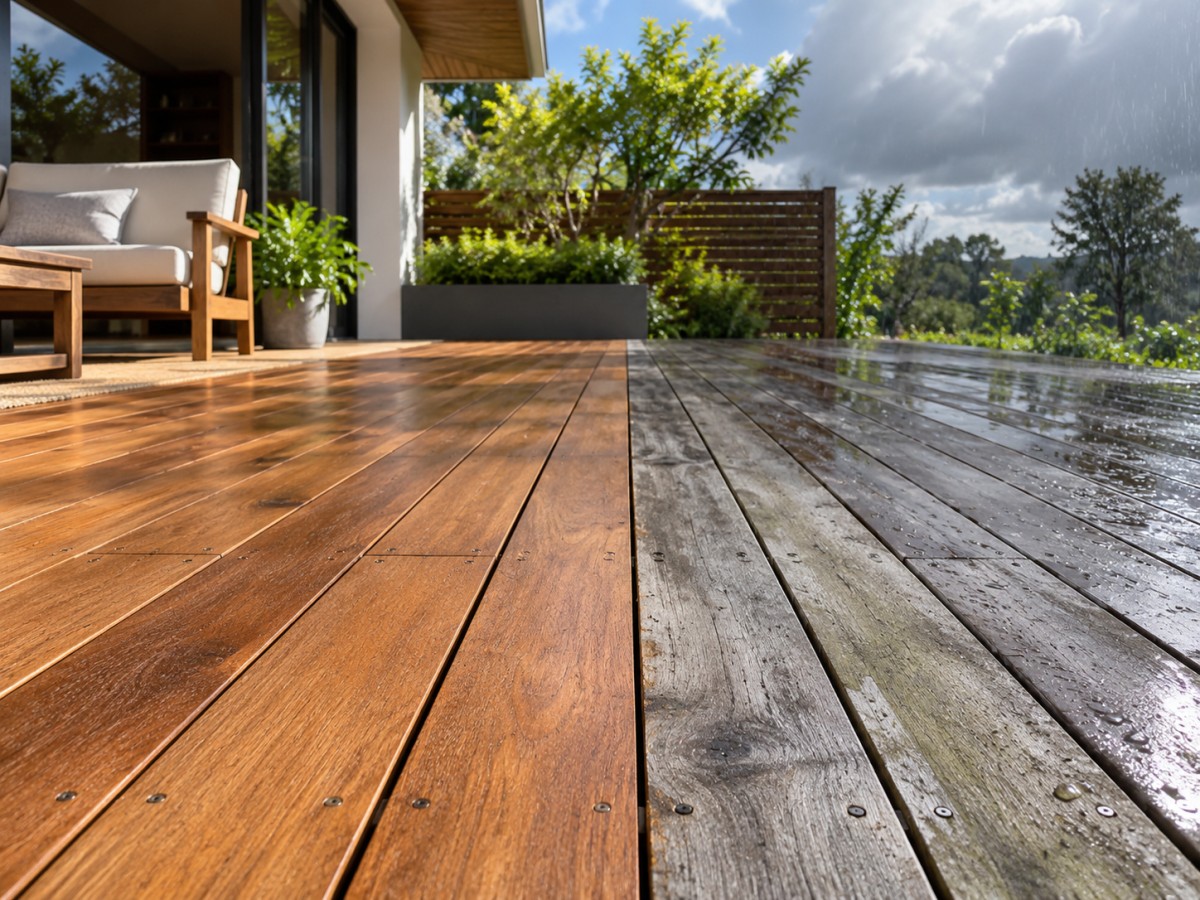
Outdoor timber naturally changes in response to sunlight, rain and humidity. Colour change is one of the most visible effects.
UV exposure alters the wood surface over time.
Depending on species and treatment, timber can lighten, darken or gradually become grey.
This does not automatically indicate structural deterioration.
Owners can choose to maintain a particular appearance using suitable treatments or allow the wood to weather naturally.
How Natural Stone Changes Outdoors
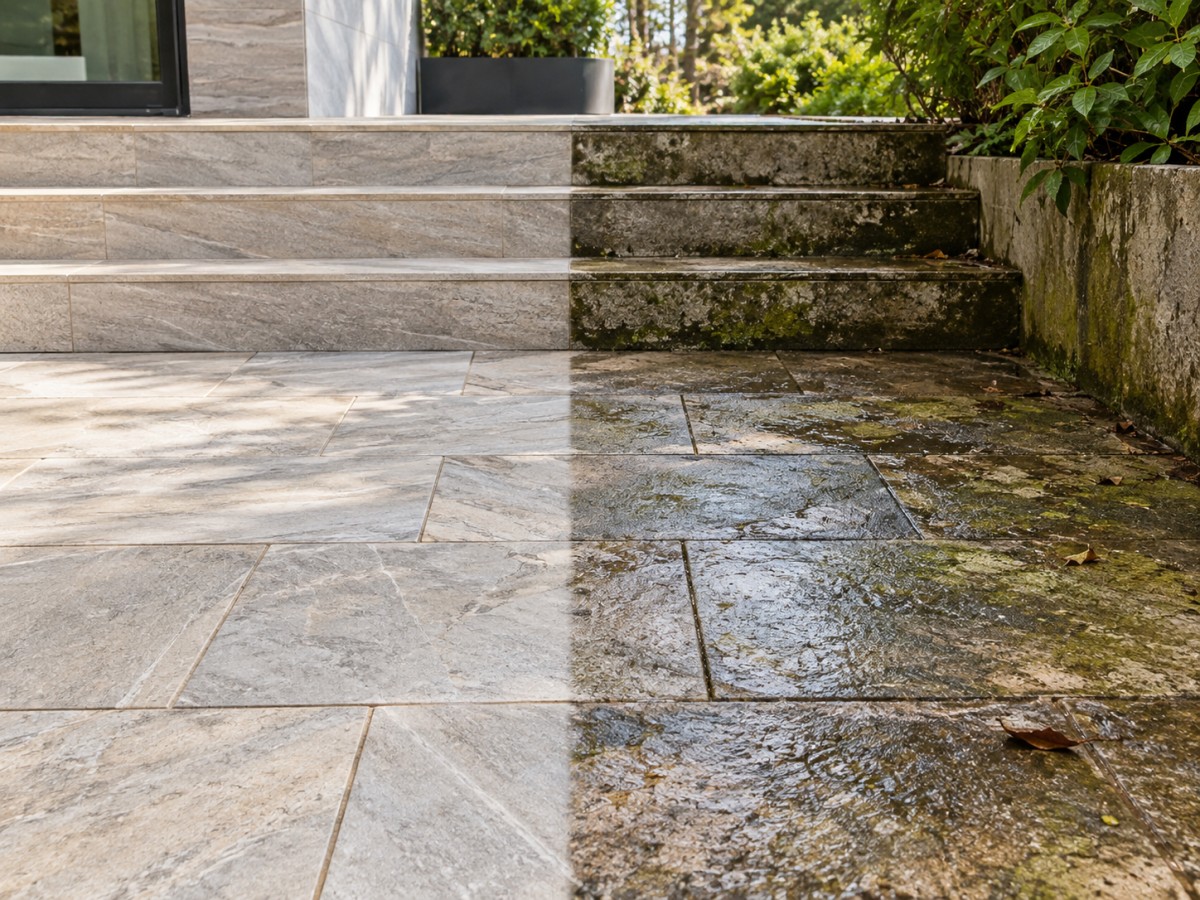
Natural stone can also change in appearance outdoors, although the process differs from timber weathering. Dirt, moisture, mineral deposits, biological growth and staining can influence the surface.
Some stone materials are more porous than others.
The stone's composition and surface finish can therefore affect how it responds to moisture and contaminants.
Stone-specific treatment may be appropriate in certain applications.
Any treatment should be compatible with the particular stone rather than applied based only on a general assumption about natural stone.
Surface Temperature and Outdoor Comfort
Surface temperature is an important consideration for Malaysian outdoor flooring because exposed areas can receive intense solar radiation. Timber and stone both become warm under direct sunlight, but their thermal behaviour differs.
Actual temperature depends on material, colour, surface finish, exposure and shade.
No outdoor surface should be assumed to remain cool throughout the day simply because it is made from a natural material.
Timber Surface Temperature
Timber can become warm under direct sunlight, but the extent depends on species, colour and exposure.
A shaded timber terrace can feel very different from the same material installed around an uncovered pool.
Board colour can also influence solar heat absorption.
For areas frequently used barefoot, the actual sun exposure should be considered before selecting the timber and overall deck design.
Shade structures and landscaping can also contribute to outdoor comfort.
Stone Surface Temperature
Natural stone can also become hot under strong sunlight.
Different stone types, colours and finishes respond differently to solar exposure.
Dark stone surfaces may warrant particular attention in open areas used barefoot.
A stone sample assessed indoors does not show how it will behave after prolonged exposure to Malaysian afternoon sun.
The specific product should therefore be considered in the context of its actual installation location.
Thermal Behaviour Should Not Be Judged by Material Name Alone
Neither "timber" nor "stone" provides enough information to predict surface temperature accurately. The actual material and environment matter.
A dark timber and a light stone may behave differently from a light timber and dark stone.
Shade, orientation and airflow also influence outdoor comfort.
For poolside decks, balconies and exposed patios, these environmental factors should be considered together rather than relying on a simple material-category comparison.
Drainage Is a Fundamental Difference
Timber decking and stone flooring commonly manage rainwater in different ways. Timber allows water to pass through board gaps, while many stone flooring systems direct water across the finished surface towards drainage points.
Both methods require proper planning.
Malaysia's heavy rainfall makes drainage a functional requirement rather than a secondary design detail.
How Timber Decking Manages Rainwater
Timber decking typically allows rainwater to pass through gaps between boards.
The water reaches the surface beneath the deck, where it should continue towards an appropriate drainage point.
The substructure should not unnecessarily block this water route.
Existing floor falls and drains therefore remain important even though they may no longer be visible after decking is installed.
Where drains need routine cleaning, suitable access should be incorporated into the decking design.
How Stone Flooring Manages Rainwater
Stone flooring generally relies on a properly designed surface and supporting installation to manage water. Depending on the system, water may be directed across the finished surface towards drains or managed through a specifically designed assembly.
Surface falls are particularly important.
A stone surface installed without suitable drainage can develop areas of standing water.
The installation should therefore account for rainfall before the stone layout and finished levels are established.
Drainage in Balconies and Terraces
Balconies and terraces often have existing floor drains and falls that should remain functional after new outdoor flooring is installed. Both timber and stone systems need to respect these conditions.
Timber can be installed above the existing surface where the appropriate substructure and height are available.
Stone installation may modify the finished floor surface more directly.
Door thresholds and drainage outlet levels should therefore be reviewed before either material is selected.
A visually attractive floor should not compromise the site's ability to remove rainwater.
Drainage in Garden Areas
Garden installations create different water-management requirements because soil, planting and surrounding landscape levels influence drainage.
Timber decks may be elevated over a suitable supporting system.
Stone can be incorporated into hardscape areas using an installation approach appropriate for the ground conditions and product.
Water should not be directed unintentionally towards the building.
The relationship between the new flooring and surrounding landscape drainage should therefore be assessed during planning.
Installation Requirements for Timber Decking
Timber decking requires a suitable supporting framework, correct board spacing and compatible fastening. The deck should be designed as a complete system rather than as timber boards placed directly over an outdoor surface.
The installation method depends on the timber and site.
Substructure
Joists support the decking boards and transfer loads to the underlying structure or supporting surface.
Joist spacing should match the selected board dimensions and expected use.
The substructure should also permit drainage and appropriate ventilation.
Board Spacing
Gaps between boards accommodate natural timber movement and allow water to pass through.
The appropriate spacing depends on timber characteristics and installation conditions.
Boards should not simply be installed as tightly together as possible.
Fastening
Suitable outdoor fasteners secure the boards to the substructure.
Dense hardwood may require pre-drilling.
Visible face fixing and compatible concealed systems can both be considered depending on the board and decking system.
Installation Requirements for Stone Flooring
Stone flooring requires an installation system appropriate for the stone, substrate and outdoor environment. The supporting base needs to be stable and properly prepared.
The exact method varies according to the application.
Supporting Base
The substrate or base needs to support the stone and intended use.
Movement or instability beneath the surface can affect the finished flooring.
Existing conditions should therefore be assessed before installation.
Joints
Stone pieces normally require appropriate joints as part of the flooring system.
Joint dimensions and materials depend on the product and installation approach.
Outdoor movement also needs to be accommodated where required.
Waterproofing and Drainage
Some balconies, terraces and building applications include waterproofing beneath the finished surface.
Any new flooring should be coordinated with the existing or proposed waterproofing system.
Waterproofing and surface drainage perform related but different functions and should not be treated as interchangeable.
Installation Height Can Influence Material Choice
Available floor height can determine whether a particular timber or stone system is practical. This is especially important for balconies, entrances and terraces beside existing doors.
Timber decking needs enough height for the boards and supporting structure.
Very low-clearance installations require careful attention to support and drainage.
Stone flooring also adds thickness through the stone and installation layers.
The final level should maintain practical thresholds and drainage relationships.
Ventilation Beneath Timber Decking
Ventilation helps the area beneath timber decking dry after rainfall and cleaning. This is especially relevant in Malaysia's humid environment.
Airflow depends on deck height and surrounding construction.
Low decks or fully enclosed edges may dry more slowly.
The design should therefore avoid unnecessarily trapping moisture beneath the boards.
Ventilation works together with drainage rather than replacing it.
Stone Flooring Does Not Use Timber-Style Under-Deck Ventilation
Conventional stone flooring does not rely on an open ventilated void in the same way as raised timber decking. Its moisture management depends on the specific installation system, substrate, joints and drainage.
This is an important structural difference between the two materials.
A stone floor should therefore not be assessed using timber-decking rules.
Likewise, timber should not be installed as though it were a rigid tiled or stone surface.
Each system needs construction appropriate to its material behaviour.
Maintenance Requirements
Timber and stone both need routine maintenance, but the tasks differ. Timber care focuses on cleaning, inspection, drainage and optional appearance treatments, while stone care depends on the surface, joints, porosity and treatment of the specific material.
Neither option should be described as completely maintenance-free.
Maintaining Timber Decking
Timber decking should be cleaned to remove leaves, dirt and other organic debris.
Board gaps and drainage routes should remain clear.
Periodic inspection can identify loose boards, fastener issues or areas that remain wet for unusually long periods.
Owners who want to maintain a particular timber colour may also choose compatible surface treatments.
Those who accept natural weathering may use a different appearance-maintenance approach.
Maintaining Natural Stone
Natural stone should be cleaned using methods compatible with the specific stone.
Different stone types can respond differently to acidic, alkaline or abrasive cleaning products.
Joints and drainage areas also require attention.
Where a stone-specific sealer or treatment is used, its maintenance requirements should be understood.
The correct approach should be based on the actual material rather than one cleaning method applied to every type of natural stone.
Mould and Algae Can Affect Both Surfaces
Mould and algae can develop on both timber and stone where moisture, shade and organic material create suitable conditions. Biological growth is therefore not exclusive to wood.
Shaded gardens and pool areas can be particularly susceptible.
Regular removal of leaves, soil and environmental deposits helps reduce conditions that support growth.
Recurring algae should also prompt inspection of drainage and drying conditions.
Changing the surface material alone may not resolve a site that remains persistently damp.
Staining and Surface Marks
Timber and stone can both develop stains, but the way they respond depends on the material. Prevention and cleaning should therefore be material-specific.
Timber can absorb certain liquids and may also contain natural extractives.
Some natural stones are porous and can absorb staining substances if they are not managed appropriately.
Outdoor dining areas deserve particular consideration because food, beverages and oils may reach the flooring.
Prompt cleaning can reduce the opportunity for contaminants to remain on either surface.
Durability and Lifespan
Durability depends on the specific timber or stone, material quality, installation and environment. Broad claims that one category always lasts longer than the other and overlooks these variables.
Suitable hardwood can provide long-term outdoor service when installed and maintained appropriately.
Suitable natural stone can also provide durable exterior flooring when the supporting system and drainage are correct.
Failures in the construction beneath either surface can affect performance.
The complete flooring system therefore matters as much as the visible material.
Timber Durability
Timber durability varies by species and board quality.
Naturally durable tropical hardwoods may be considered for demanding exterior environments.
Heartwood content and environmental exposure can also influence performance.
Persistent moisture, inadequate ventilation or unsuitable support can reduce favourable conditions around even durable timber.
Material selection and construction should therefore be considered together.
Stone Durability
Natural stone durability varies according to mineral composition, porosity, thickness, finish and intended application.
A stone suitable for one exterior environment is not automatically suitable for every other location.
The supporting substrate and installation system also influence performance.
Cracking or movement can sometimes originate below the visible stone rather than within the material itself.
Outdoor suitability should therefore be confirmed for the specific product and installation.
Repairing Timber Decking
Individual timber boards can often be replaced when damage is localised and the substructure remains suitable. This can make local repairs possible without removing the entire deck.
Replacement boards may initially differ in colour.
Existing timber has already experienced sunlight and weathering, while the new board has not.
The cause of damage should also be investigated.
Repeated board problems may indicate an underlying drainage or support issue.
Repairing Stone Flooring
Individual stone pieces can sometimes be replaced when compatible material is available and the installation allows local removal.
Matching can be difficult because natural stone varies and replacement material may come from a different batch or source.
Repair should also address the cause of the damage.
If cracking is related to movement in the supporting system, replacing only the visible stone may not provide a lasting solution.
Long-Term Material Availability
Future material availability can affect both timber and stone repairs. Natural products are inherently variable and may not provide an exact visual match years after installation.
Timber replacement is influenced by species availability, board dimensions and weathering.
Stone replacement is influenced by quarry source, batch variation, product availability and natural mineral differences.
Keeping clear records of the material specification can make future maintenance easier.
Designing the surface with localised replacement in mind can also improve serviceability.
Timber Versus Stone Around Swimming Pools
Poolside flooring should accommodate frequent water exposure, sunlight, cleaning and barefoot use. Both suitable timber and appropriate natural stone may be considered.
The actual surface characteristics matter more than the broad material category.
Timber boards should remain well maintained, securely fixed and free from problematic surface deterioration.
Stone should have characteristics appropriate for wet outdoor use.
Surface temperature is also important because uncovered pool surrounds can receive prolonged direct sunlight.
Timber Versus Stone for Balconies
Balconies require particular attention to installation height, drainage, thresholds and building requirements. Timber and stone can create very different construction solutions.
Timber can form a raised board surface over an existing balcony where conditions allow.
Water can continue beneath the deck towards existing drainage.
Stone typically forms a harder finished flooring surface integrated more directly with the balcony's floor system.
The existing structure and waterproofing should be considered before significant flooring changes are made.
Timber Versus Stone for Patios
Patios can use timber or stone depending on the desired relationship with the house and landscape. Both materials can create seating and dining areas.
Timber creates a board-based natural surface with visible grain.
Stone provides a more solid hardscape character.
The surrounding architecture may influence the visual preference, but rainfall, sunlight and cleaning should also be considered.
Covered and uncovered patios can create very different exposure conditions.
Timber Versus Stone for Gardens
Timber and stone can both integrate naturally with garden environments, but they create different visual and functional effects.
Timber can form raised platforms, walkways and seating areas that contrast with planting.
Stone can create patios, paths and hardscape zones with a more grounded mineral appearance.
Ground conditions are important for both.
Landscape drainage, soil levels, tree roots and surrounding vegetation should be considered before selecting the flooring system.
Timber Versus Stone for Commercial Spaces
Commercial outdoor flooring should support the traffic, cleaning and operational requirements of the property. Restaurants, hotels and resorts may use timber, stone or a combination of both.
Timber can support a natural hospitality design.
Stone can provide a substantial hardscape finish for entrances, terraces and circulation areas.
Material selection should also consider furniture movement, cleaning practices and maintenance access.
Any project-specific structural, accessibility and safety requirements should be addressed separately from aesthetic preferences.
Can Timber and Stone Be Used Together?
Timber and stone can be combined within the same outdoor design when transitions, drainage and construction are properly planned. The contrast between wood grain and mineral texture can help define different functional areas.
For example, timber may be used for a seating platform while stone forms surrounding paths.
The materials do not need to compete for the same role.
Their different finished heights and construction systems should be coordinated carefully.
Water should also move correctly across and between the two surfaces.
Which Material Offers More Design Flexibility?
Timber and stone offer different forms of design flexibility. Timber can be arranged using board direction and decking layouts, while stone can vary through size, pattern, texture and joint arrangement.
The practical limits depend on construction.
Complex timber patterns may require additional substructure and cutting.
Complex stone layouts may require additional cutting and careful setting out.
Design features should therefore be selected because they serve the space rather than adding unnecessary installation complexity.
Cost and Long-Term Considerations
The overall requirements of timber and stone flooring depend on material selection, site conditions, installation complexity and long-term maintenance. A meaningful comparison should consider the complete system rather than a generic material rate.
No specific price comparison applies to every project.
Natural timber varies by species, grade, dimensions and sourcing.
Natural stone varies by type, thickness, finish, format and origin.
The supporting construction can also differ substantially.
For this reason, two similarly sized outdoor areas may have very different project requirements even before the surface material is selected.
Initial Project Requirements
Initial requirements include more than the visible timber boards or stone pieces. Preparation and supporting construction can form a substantial part of either system.
For timber, the project may include substructure, fasteners, board preparation and edge details.
For stone, requirements can include substrate preparation, installation materials, joints and surface treatment where appropriate.
Drainage and existing site conditions affect both.
Comparisons should therefore use equivalent project scopes.
Long-Term Ownership Requirements
Long-term ownership involves cleaning, inspection and possible local repair for both timber and stone. The type of maintenance differs.
A comparison can help clarify the distinction.
| Long-Term Factor | Timber Decking | Natural Stone |
|---|---|---|
| Routine cleaning | Required | Required |
| Colour change | Natural weathering expected | Material-specific ageing |
| Surface treatment | Optional depending on desired finish | Stone-specific treatment may apply |
| Drainage inspection | Required | Required |
| Local repair | Board replacement may be possible | Individual stone replacement may be possible |
| Matching repairs | Affected by weathering and wood variation | Affected by natural variation and availability |
| Biological growth | Possible in damp conditions | Possible in damp conditions |
| Supporting system | Substructure needs inspection where accessible | Substrate/system condition remains important |
The more suitable maintenance profile depends on the property and owner expectations.
Choosing Between Timber and Stone
Choosing between timber and stone requires matching the flooring system to the site's environmental, functional and design requirements. The decision should begin with how the space works.
A practical assessment can follow several steps.
Identify the Outdoor Application
Determine whether the area is a balcony, patio, garden, pool surround or commercial space.
Different applications create different surface and construction requirements.
Assess Rainfall and Drainage
Identify where rainwater currently flows.
Determine whether a board-based raised system or a stone flooring system works appropriately with those conditions.
Assess Sun and Heat Exposure
Consider how many hours of direct sunlight reach the area.
This is particularly important for barefoot and frequently occupied spaces.
Consider the Desired Material Character
Choose whether natural wood grain or natural mineral texture better suits the design.
Both materials offer genuine variation but create different visual effects.
Review Maintenance Expectations
Consider cleaning, weathering and any appearance-focused treatments.
Owners should understand how the selected material is likely to change outdoors.
Evaluate the Complete Installation
Review substructure or substrate, finished floor height, drainage, access and transitions.
The surface material should be compatible with the complete construction.
Common Mistakes When Comparing Timber and Stone
Timber and stone comparisons can become misleading when natural appearance is treated as their only common characteristic. Their construction and behaviour are substantially different.
Assuming Natural Materials Need No Maintenance
Both wood and stone require cleaning and inspection.
Natural origin does not make an outdoor surface maintenance-free.
Choosing Only by Appearance
A sample cannot show how a material interacts with the site's drainage, sunlight and supporting construction.
Technical conditions should be assessed alongside design.
Assuming All Stone Is the Same
Granite, slate, quartzite and other stones have different characteristics.
Outdoor suitability should be assessed for the actual material.
Assuming All Timber Is the Same
Chengal, Merbau, Balau and other hardwoods also differ.
Species and material quality should be identified before comparison.
Ignoring What Is Beneath the Surface
Both systems depend on their supporting construction.
An appropriate surface material cannot compensate for an unsuitable substructure, substrate or drainage arrangement.
Frequently Asked Questions (FAQs)
Is timber decking better than natural stone?
Neither material is universally better. Timber provides a natural wood board surface, while stone provides a hard mineral surface. The appropriate option depends on drainage, exposure, intended use, design and maintenance expectations.
Which is better for Malaysia's rainy climate?
Suitable timber and appropriate natural stone can both be used in Malaysia. Timber decking needs effective drainage beneath the boards, while stone flooring needs a suitable installation and surface drainage system.
Which gets hotter, timber or stone?
Both can become hot under direct sunlight. Surface temperature depends on the specific material, colour, finish, duration of exposure and shade rather than simply whether the surface is timber or stone.
Is timber or stone better around a swimming pool?
Both can be considered when the specific material is suitable for poolside use. Surface characteristics, heat, drainage, barefoot use and maintenance should guide the selection.
Does natural stone require maintenance?
Yes. Stone requires routine cleaning, while joints and drainage also need attention. Some stone materials may use compatible treatments depending on their porosity and application.
Does timber require more maintenance than stone?
Timber may involve additional appearance-focused maintenance when owners want to preserve a particular colour or finish. Both timber and stone still require cleaning and inspection, so actual maintenance depends on the chosen materials and site.
Can timber decking be installed beside stone flooring?
Yes. Timber and stone can be combined where finished levels, transitions, drainage and construction are coordinated correctly. Using both materials can also help define different outdoor zones.
Which material is easier to repair?
Both can allow localised repair in some installations. Timber boards may be individually replaced, while individual stone pieces may sometimes be replaced if matching material is available and the system allows removal.
Is stone more durable than timber?
Durability cannot be determined from the broad material category alone. Timber durability depends on species, quality, installation and moisture conditions, while stone durability depends on the stone type, supporting system, installation and exposure.
Which should I choose for an outdoor terrace?
Assess rainfall, sunlight, drainage, intended use, desired appearance and maintenance expectations. Natural timber may suit a board-based wood aesthetic, while stone may suit a harder architectural surface.
Matching the Surface to the Outdoor Environment
Timber decking and natural stone can both provide distinctive outdoor flooring, but their material behaviour and construction are fundamentally different. Timber creates a natural wood surface over a supporting substructure, while stone creates a mineral-based hard surface using a different installation approach.
Malaysia's climate makes these technical differences important. Heavy rain requires effective drainage, high humidity makes moisture management relevant, and strong sunlight can affect both surface temperature and appearance.
Timber naturally weathers and can often be refinished when owners want to manage its appearance. Natural stone has different cleaning, staining and treatment considerations according to the specific material.
The timber decking vs stone decision should therefore be based on the complete outdoor environment. Understanding drainage, heat, maintenance, installation and long-term use makes it easier to choose a flooring system that fits the actual space rather than relying only on visual preference.