
For the best outdoor decking material in Malaysia, these can be used for properties depending on how well the material suits rainfall, humidity, sunlight, heat, drainage conditions and the intended use of the outdoor space. There is no single decking material that is automatically the best choice for every balcony, garden, terrace, poolside area or commercial property.
Malaysia's tropical climate creates demanding conditions for outdoor flooring materials. Decking can be exposed to frequent heavy rain, high year-round humidity, strong UV radiation and repeated changes between wet and dry conditions.
Natural timber and WPC composite are two common outdoor decking options. Timber provides genuine wood grain and natural variation, while WPC provides a manufactured composite surface with more consistent appearance and different maintenance requirements.
Choosing between these outdoor flooring materials requires more than comparing appearance. Material behaviour, moisture exposure, drainage, ventilation, installation and maintenance should be assessed together so that the selected decking is appropriate for the specific outdoor environment.
HOW MALAYSIA'S CLIMATE AFFECTS OUTDOOR DECKING
Malaysia's climate affects outdoor decking through frequent moisture exposure, high humidity, solar radiation and heat. A suitable decking material needs to function within these conditions rather than simply look appropriate when newly installed.
Climate exposure varies between properties. A covered condominium balcony may receive limited direct rain but substantial humidity. An open garden terrace can receive both heavy rainfall and full sunlight, while a shaded poolside deck may remain damp for longer periods.
The site should therefore be assessed according to its actual microclimate rather than the general Malaysian climate alone.
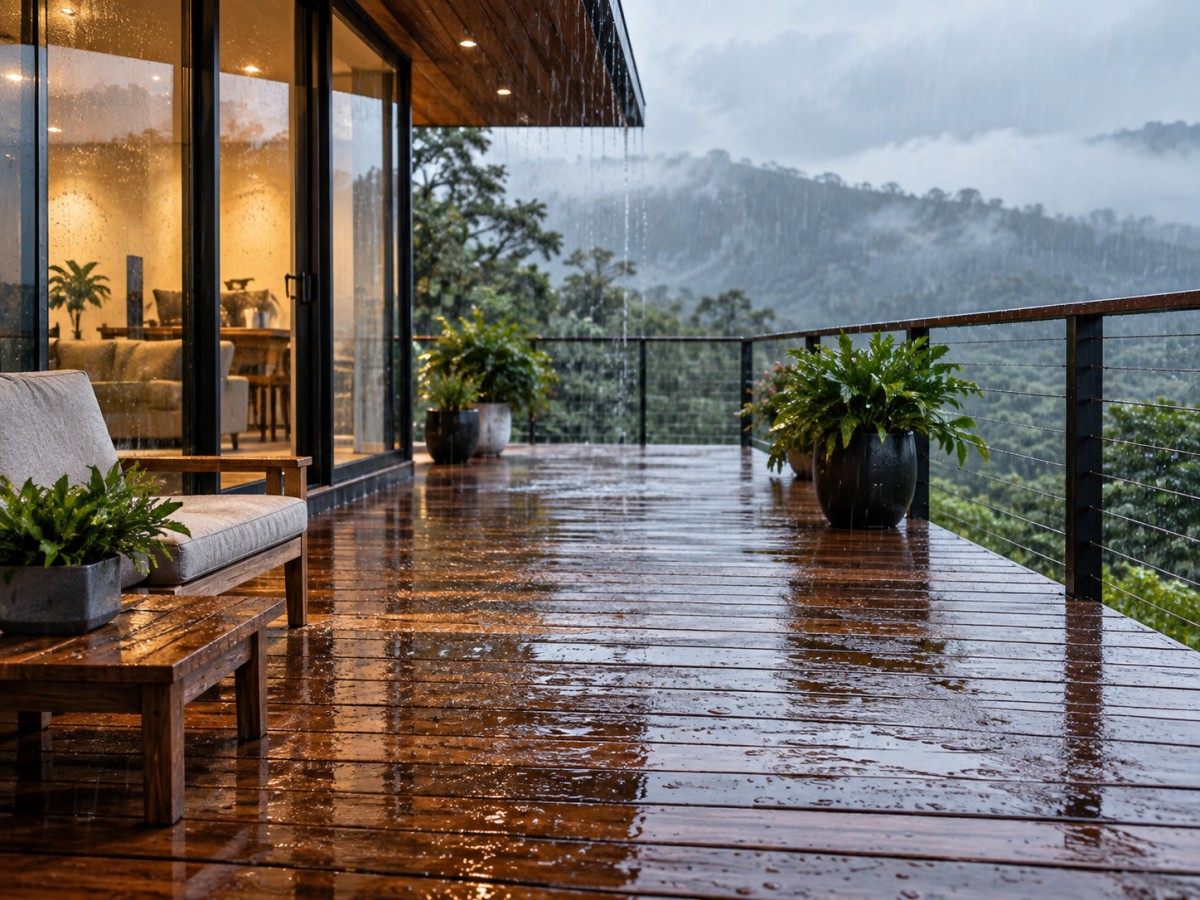
Rainfall Is a Major Decking Consideration
Frequent rainfall means outdoor decking in Malaysia should be designed to become wet and then drain effectively. Trying to prevent all contact with rain is generally unrealistic for exposed exterior spaces.
Material selection is only one part of managing rainfall.
Surface Water
Rainwater lands directly on exposed decking and should be able to move away from the walking surface.
Deck boards normally have gaps that allow water to pass through. These gaps need to remain sufficiently clear of dirt and organic debris to continue functioning.
Water Beneath the Deck
Water passing between boards needs a clear route beneath the decking.
An existing concrete surface may direct water towards floor drains, while a landscape installation may use a different drainage arrangement. The substructure should not create unnecessary barriers that trap water.
Wind-Driven Rain
Covered spaces are not always dry spaces.
Balconies and terraces can receive wind-driven rain even when they have a roof or another balcony overhead. Material selection should therefore consider actual exposure rather than classifying every covered deck as protected from moisture.
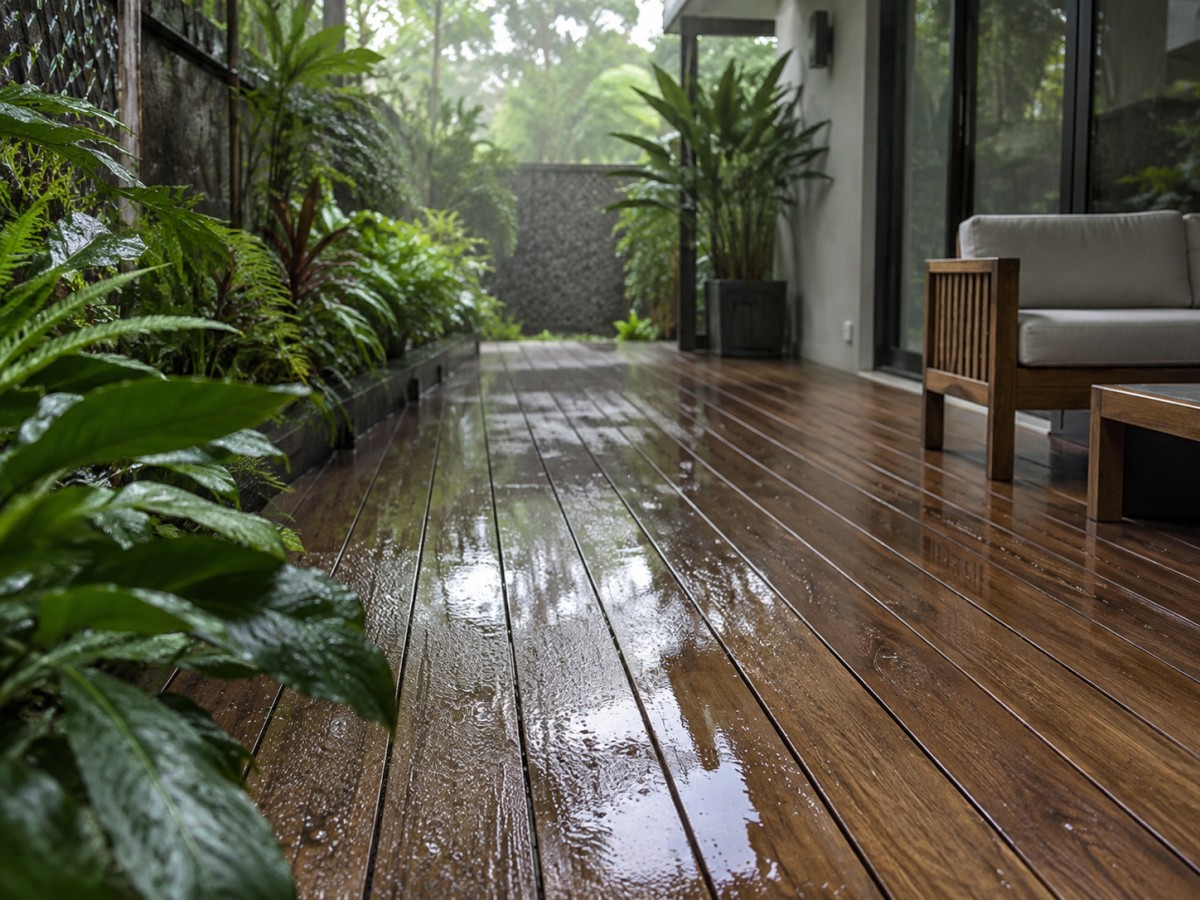
High Humidity Influences Outdoor Materials
High humidity can slow drying and contribute to persistent moisture around outdoor decking. This is particularly relevant in shaded or poorly ventilated spaces.
Malaysia's humidity affects natural timber and composite systems differently, but neither should be installed without considering moisture management.
Humidity and Timber
Timber is hygroscopic, meaning it exchanges moisture with the surrounding environment.
Changes in moisture conditions can cause natural dimensional movement. Suitable board spacing, support and ventilation help accommodate this behaviour.
Humidity and WPC
WPC contains polymer and wood-derived material, so it does not behave exactly like solid timber.
However, a WPC deck can still remain damp when water and debris are trapped around or beneath the boards. Routine cleaning, drainage and airflow therefore remain relevant.
Shaded Humid Areas
Courtyards, areas beneath dense trees and enclosed balconies may remain damp longer after rainfall.
These locations can encourage mould or algae on outdoor surfaces when dirt and organic material accumulate. Material selection should be accompanied by a realistic maintenance plan for these environments.
UV Exposure
UV radiation contributes to colour change in outdoor materials.
Natural timber commonly changes colour as its surface weathers. Depending on species and treatment, it may lighten, darken or gradually develop a grey appearance. WPC products can also experience product-specific changes under prolonged exposure.
The expected weathered appearance should therefore be considered during selection.
Surface Temperature
All outdoor flooring can become warm when exposed to direct Malaysian sunlight.
Material composition and colour can influence how a surface absorbs and releases heat. This is especially relevant for poolside decks and other areas where users may walk barefoot.
Shade Conditions
Shade can improve outdoor comfort by reducing direct solar exposure.
However, shaded decking can dry more slowly after rainfall. Material selection should therefore balance heat exposure with moisture and drying conditions.
What Should an Outdoor Decking Material Handle?
An outdoor decking material should be suitable for the environmental exposure and functional demands of its intended location. The required characteristics depend on whether the deck is residential, landscape, poolside or commercial. Useful selection criteria include:
- ✓ Suitability for repeated outdoor moisture exposure.
- ✓ Ability to work with the required drainage system.
- ✓ Appropriate response to heat and UV exposure.
- ✓ Compatibility with the intended substructure.
- ✓ Realistic maintenance requirements.
- ✓ Suitability for the expected pedestrian and furniture use.
These criteria provide a more practical basis for selection than choosing a material only because it is described as weather-resistant.
NATURAL TIMBER DECKING FOR MALAYSIA
Natural timber decking is made from solid wood boards and provides genuine grain, colour variation and material texture. Suitable hardwood species can be considered for Malaysia's tropical outdoor environment when material quality, installation and maintenance are appropriate.
Timber should be selected by species rather than by the broad hardwood category alone.
Natural Timber and Moisture
Timber naturally absorbs and releases moisture. This behaviour means boards can expand and contract as conditions change.
Correct board spacing and appropriate fastening are therefore necessary. Drainage and ventilation also help the timber dry after rainfall.
Natural Timber and Sunlight
Timber changes colour under UV exposure. This weathering is a natural surface process and does not automatically indicate that the board has structurally deteriorated.
Owners who want to maintain a particular timber colour may use compatible surface treatments as part of their maintenance programme.
Natural Timber Appearance
One of timber's distinguishing characteristics is genuine natural variation. Boards from the same species can differ in grain and colour.
This makes timber suitable where an authentic wood surface is part of the design intent.
Chengal for Outdoor Decking
Chengal is a Malaysian tropical hardwood associated with exterior and structural uses. Its density and natural durability characteristics make it relevant when considering hardwood decking for outdoor environments.
Chengal still needs appropriate construction. Drainage, ventilation, board spacing and suitable fasteners remain necessary even when naturally durable timber is selected. Availability, sourcing and the quality of the actual boards should also be considered. The species name alone should not replace assessment of the material being supplied.
Merbau for Outdoor Decking
Merbau is a dense tropical hardwood commonly associated with flooring and exterior applications. It typically provides warm brown to reddish-brown tones with natural grain variation.
Merbau can be considered for suitable Malaysian outdoor spaces. Its natural extractives can sometimes produce coloured runoff during early exposure to water. This characteristic should be considered where the deck is positioned beside pale walls, tiles or other surfaces that could be affected by runoff.
Balau for Outdoor Decking
Balau is a commercial timber name associated with several dense Shorea timbers. It is commonly considered for outdoor uses because of the characteristics associated with these tropical hardwoods.
Material identification is important. Different timber may be marketed under the broader Balau name. Buyers should therefore review actual board quality and suitability rather than assuming every Balau product is identical.
Other Hardwood Decking Options
Other hardwoods, including Belian and teak, may be considered for specific outdoor decking projects. Their suitability depends on the material, availability, sourcing and site requirements.
The most appropriate timber is not necessarily the species with the strongest general reputation. A suitable selection needs to match the actual environment and project. For example, installation access, board dimensions and maintenance expectations can affect whether a particular hardwood is practical for the site.
WPC COMPOSITE DECKING FOR MALAYSIA
WPC decking is a manufactured material generally combining wood-derived content with thermoplastic polymers and other formulation components. It provides a different approach to outdoor decking from solid natural timber.
WPC products vary significantly. Board profile, formulation, surface construction and fastening requirements should therefore be evaluated at product level.
WPC and Moisture
WPC does not behave like solid timber when exposed to moisture. It generally does not require timber-style surface treatment to manage the same natural wood weathering process.
However, WPC decking still needs effective drainage. Standing water, dirt and organic deposits can affect the condition of the deck environment even when the boards themselves are composite.
WPC and Heat
Composite boards can become warm in direct sunlight. Surface temperature depends on factors including product composition, colour, orientation and exposure.
A small sample viewed indoors does not provide a complete indication of how the surface will feel after several hours of direct Malaysian sun.
WPC and UV Exposure
Outdoor WPC is manufactured for exterior use, but appearance can still change with environmental exposure. The extent varies by product.
Product-specific information should therefore be reviewed rather than assuming all WPC responds identically to sunlight.
WPC Board Construction Matters
WPC should not be treated as one uniform decking product. Board construction influences weight, installation, fastening and other characteristics. Several broad configurations are available:
Solid WPC Boards: Solid boards have a largely solid internal profile. Their support and fastening requirements depend on the manufacturer's system. A solid profile should not automatically be interpreted as appropriate for every application.
Hollow WPC Boards: Hollow boards use internal cavities within the board profile. This changes the board construction and can influence installation details. End finishing and support should follow the requirements of the particular system.
Capped WPC Boards: Some WPC products use an outer protective layer around the composite core. The cap can influence surface appearance and maintenance characteristics. The quality and construction of capped products vary, so the actual product specification should be reviewed.
TIMBER VERSUS WPC FOR MALAYSIA'S CLIMATE
Timber and WPC can both be used in Malaysian outdoor environments when the selected product and complete decking system suit the site. Their differences are primarily in material composition, appearance, movement and maintenance.
A direct comparison can clarify the main distinctions.
| Consideration | Natural Timber | WPC Composite |
|---|---|---|
| Material | Solid natural wood | Wood-derived material with polymer |
| Appearance | Genuine grain and natural variation | Manufactured, generally more consistent |
| Moisture behaviour | Absorbs and releases moisture | Product-specific composite behaviour |
| Movement | Influenced strongly by moisture | Thermal movement is important |
| UV exposure | Natural surface weathering | Product-specific appearance change |
| Surface treatment | May be used to maintain appearance | Generally no timber-style refinishing |
| Routine cleaning | Required | Required |
| Board selection | Species and material quality | Product formulation and profile |
| Installation | Timber-specific spacing and fastening | Product-specific spacing and fastening |
Neither column represents an automatic advantage in every situation. The correct interpretation depends on the project requirements.
WEATHER RESISTANCE SHOULD BE EVALUATED AS A SYSTEM
Weather resistance is not determined by the decking board alone. The supporting structure, spacing, drainage and ventilation all affect how the deck responds to tropical weather.
A highly durable board installed over a poorly drained surface can still experience problems. Similarly, selecting WPC does not remove the need to manage water beneath the deck. The complete system should therefore be considered when evaluating outdoor flooring materials.
Why Drainage Matters Regardless of Material
Drainage is essential because Malaysia's rainfall can introduce substantial amounts of water to an outdoor deck. The system should allow this water to leave efficiently.
Both timber and WPC normally use gaps between boards. Water passing through these gaps should then move towards the site's drainage system. The substructure should not block existing falls or outlets. Drainage points that require maintenance should remain accessible.
Why Ventilation Matters
Ventilation helps the space beneath decking dry after rainfall and cleaning. It is particularly important for natural timber but also contributes to a better under-deck environment for composite systems.
The available airflow depends on deck height and perimeter conditions. An elevated garden deck may naturally receive more airflow than a very low balcony installation. Completely enclosing deck edges without considering ventilation can create less favourable moisture conditions. The required approach should be planned for the actual system.
Consider the Substructure Before Choosing Decking
The substructure supports the decking boards and determines how the finished surface works with the site. Material selection should therefore consider the available supporting system from the beginning. Different boards can require different joist spacing.
Timber Substructure Requirements: Natural timber boards need appropriate support according to their species, dimensions and orientation. Dense hardwood also requires compatible fastening. The supporting components themselves need to be suitable for the outdoor environment.
WPC Substructure Requirements: WPC products commonly have manufacturer-defined support intervals and fastening systems. These requirements can vary between products. Installation instructions from one WPC board should not automatically be applied to another.
MAINTENANCE REQUIREMENTS SHOULD MATCH THE OWNER
The best decking material is partly determined by the amount and type of maintenance the owner is prepared to carry out. No outdoor decking should be assumed to remain clean and unchanged without care.
Timber and WPC have different maintenance profiles.
Timber Maintenance
Timber requires routine cleaning and inspection.
Owners who want to maintain a particular colour or finish may also use compatible surface treatments. Those comfortable with natural weathering may choose a different appearance-maintenance approach.
WPC Maintenance
WPC requires regular debris removal and cleaning.
Spills and organic growth should be addressed using methods appropriate for the product. Although timber-style refinishing is generally not required, this does not make WPC maintenance-free.
Mould and Algae Can Affect Outdoor Decking
Mould and algae can develop on outdoor surfaces when moisture, shade and organic material create suitable conditions. This can occur around both timber and WPC decking.
The surrounding environment is an important factor. A shaded garden deck beneath trees may experience more organic deposits than an exposed balcony. Routine cleaning and effective drainage help reduce conditions that encourage growth.
Recurring mould or algae should prompt inspection of moisture, airflow and debris accumulation rather than simply repeated surface cleaning.
MATCH MATERIAL TO THE ACTUAL OUTDOOR SPACE
Decking selection becomes easier when the material is compared against the conditions of the specific application. Different spaces create different priorities.
Choosing Decking for an Exposed Balcony
An exposed balcony needs decking that can accommodate direct rainfall, sunlight and limited installation height. Existing drains and door thresholds often create important constraints.
Both suitable timber and WPC may be considered. Natural timber provides genuine wood character but will weather under UV exposure. WPC provides a more manufactured and consistent surface, although direct sun and thermal movement still need consideration.
The available substructure height and drainage arrangement may ultimately influence which system is practical.
Choosing Decking for a Covered Balcony
A covered balcony may receive less direct rainfall but can still experience humidity and wind-driven rain. Shade can also slow drying.
The material should therefore still be suitable for outdoor use. Timber may be appropriate where natural appearance is preferred, while WPC may suit owners looking for a more consistent manufactured finish.
Neither should obstruct existing balcony drainage. Building or condominium requirements should also be checked where applicable.
Choosing Decking for a Garden
Garden decking should be selected with soil, vegetation, rainfall and organic debris in mind. Garden environments can remain damp because plants and shade affect airflow and drying.
Natural timber can integrate visually with landscaping. WPC can provide a consistent manufactured alternative.
For either material, the supporting system should work with the ground conditions, and leaves should not be allowed to accumulate beneath or between boards.
Choosing Decking for a Patio or Terrace
Patio and terrace decking should be selected according to exposure, intended furniture use and connection with the building. These spaces can range from fully sheltered to completely open.
An exposed terrace needs strong attention to rainfall and UV. A covered patio may place more emphasis on humidity and cleaning.
Material selection should also account for the desired relationship with indoor flooring and surrounding architecture without compromising outdoor performance.
Choosing Decking for Poolside Areas
Poolside decking needs to function under frequent wetting, direct sunlight and barefoot use. Material and surface characteristics should therefore be evaluated carefully.
Drainage is especially important. Water from swimmers, cleaning and rainfall should not remain unnecessarily on or beneath the deck. Surface temperature should also be considered where the pool receives strong direct sunlight.
Both timber and suitable WPC products may be considered, but the specific material should be assessed for the intended environment.
Choosing Decking for Commercial Properties
Commercial decking needs to accommodate the traffic and operational requirements of the property. Restaurants, hotels and resorts may experience frequent furniture movement, cleaning and pedestrian use.
Durability should therefore be evaluated together with maintainability. A commercial deck should also provide practical access for cleaning and inspection.
Where applicable, project-specific structural, accessibility, fire and safety requirements need to be addressed independently of the surface material.
| Outdoor Space | Main Conditions to Assess | Material Selection Priorities |
|---|---|---|
| Exposed balcony | Rain, UV, limited height | Drainage, movement, system compatibility |
| Covered balcony | Humidity, shade, wind-driven rain | Drying, appearance, maintenance |
| Garden | Soil, vegetation, organic debris | Moisture management, outdoor durability |
| Patio | Furniture, mixed exposure | Appearance, maintenance, drainage |
| Poolside | Water, sun, barefoot use | Surface suitability, heat, drainage |
| Restaurant | Traffic, spills, furniture | Cleaning, durability, serviceability |
| Hotel or resort | Traffic, landscape exposure | Appearance, maintenance, system durability |
This framework helps narrow the options without declaring one material suitable for every situation.
PRACTICAL DECKING CONSIDERATIONS
Appearance Should Be Evaluated Over Time
Outdoor decking should be selected according to how it is expected to look after exposure, not only its appearance when new. Malaysia's sunlight and rainfall mean surfaces will change.
Natural timber develops weathering and colour variation. Some owners consider this part of the material's character, while others prefer to maintain a particular finish. WPC generally provides greater initial colour consistency, but product-specific changes can still occur outdoors. Expectations should therefore be established before installation.
Consider Material Movement
Outdoor decking materials move in response to environmental conditions. The type of movement differs between timber and WPC.
Natural timber responds strongly to changes in moisture. WPC requires consideration of thermal expansion and contraction. Correct gaps and fastening methods are therefore essential for both. The installer should understand the requirements of the specific material rather than applying one spacing rule to every decking product.
Consider Cleaning Before Selecting a Material
Cleaning requirements should be realistic for the property and how the deck will be used. Outdoor surfaces collect dust, leaves, spills and other environmental material.
Residential balconies may require relatively straightforward routine cleaning. Garden decks can collect more organic material. Restaurant terraces may require frequent cleaning because of food, beverages and daily customer use. Material selection should consider whether the proposed surface and layout can be maintained practically under these conditions.
Consider Repairability and Future Access
Decking should be planned so that localised maintenance and necessary access remain practical. Drains, services and other components beneath the deck may require future attention.
Individual timber boards can often be addressed locally where the system permits. WPC boards may also be replaceable depending on the fastening system and availability of compatible components. Replacement material may not perfectly match older weathered boards. Future access should therefore be considered during the initial layout rather than only after a problem occurs.
COMMON MISTAKES WHEN CHOOSING OUTDOOR DECKING
Outdoor decking choices can become less reliable when one feature is allowed to dominate the entire decision. The material should be assessed as part of a complete outdoor system.
Choosing Only by Appearance
A sample can show colour and texture but not drainage, movement or long-term weathering.
Appearance should therefore be considered after the site requirements are understood.
Assuming "Outdoor" Means Maintenance-Free
Outdoor-rated materials still need cleaning and inspection. Rain, leaves, mould and spills do not disappear because a product is designed for exterior use.
Maintenance expectations should be discussed before selection.
Assuming All Timber Is the Same
Timber species differ in natural durability, density, colour and movement. Board quality can also vary within the same species.
The actual material should be identified.
Assuming All WPC Is the Same
WPC formulations and board profiles vary between manufacturers and products. Solid, hollow, capped and uncapped boards can have different characteristics.
Product-specific information should therefore guide selection.
Ignoring the Existing Drainage
A new deck should not hide an unresolved drainage problem. Existing water routes need to remain functional after installation.
This applies to both timber and WPC.
A PRACTICAL PROCESS FOR CHOOSING OUTDOOR DECKING
A structured selection process helps prevent the decision from being based only on a sample board or general material label. The site should determine the requirements before the final material is chosen.
Questions to Ask Before Choosing a Decking Material
Useful questions help compare different decking proposals using consistent criteria. Answers should relate to the actual product and site. Consider asking:
- ✓ What exactly is the timber species or WPC product?
- ✓ Is it suitable for the intended outdoor application?
- ✓ How will it respond to the site's rain and sunlight exposure?
- ✓ What substructure and spacing does it require?
- ✓ How will water drain beneath the deck?
- ✓ What maintenance should be expected?
These questions provide more useful information than asking only which material is described as the most durable.
FREQUENTLY ASKED QUESTIONS (FAQS)
What is the best outdoor decking material in Malaysia?
There is no single best material for every Malaysian property. Suitable timber and WPC can both be considered, depending on rainfall exposure, sunlight, drainage, intended use, desired appearance and maintenance expectations.
Is timber suitable for Malaysia's rainy climate?
Yes. Suitable outdoor timber can be used in Malaysia when the species, board quality, installation, drainage and ventilation are appropriate. Timber should be allowed to drain and dry after rainfall.
Is WPC suitable for Malaysia's climate?
Suitable WPC products can be used in Malaysian outdoor environments. Product-specific requirements for support, thermal movement, drainage, cleaning and UV exposure should still be considered.
Which decking material needs less maintenance?
WPC generally requires less timber-specific surface refinishing, while natural timber may require treatment where a particular colour or finish is to be maintained. Both materials still require cleaning and inspection.
Does timber decking rot in Malaysia?
Timber deterioration depends on species, material quality and environmental conditions. Naturally durable hardwood can support outdoor use, but persistent trapped moisture and unsuitable construction can create unfavourable conditions for any timber deck.
Does WPC decking get hot in Malaysia?
WPC can become warm under direct sunlight. Surface temperature depends on product composition, colour, exposure and shade. Specific products should be evaluated for locations where barefoot comfort is important.
Which material is suitable for pool decking?
Both suitable timber and appropriate WPC products may be considered for poolside areas. The specific material should be evaluated for frequent wetting, surface condition, sunlight, heat and drainage.
What decking is suitable for a condominium balcony?
Timber and WPC can both be considered where the balcony's installation height, drainage, exposure and building requirements allow. The complete decking system should not obstruct existing drains or door thresholds.
Is hardwood always better for outdoor decking?
No. Hardwood is a broad classification and does not mean every species has the same exterior characteristics. Timber species, board quality and construction should be evaluated individually.
Should decking colour affect material selection?
Colour can influence design and surface heat, particularly under direct sunlight, but it should not be the only selection factor. Drainage, exposure, material behaviour and maintenance are more fundamental considerations.
SELECTING DECKING FOR MALAYSIA'S OUTDOOR CONDITIONS
Choosing outdoor decking in Malaysia requires matching the material to the environment rather than searching for one product that is universally superior. Rainfall, humidity, UV exposure, heat and local site conditions all affect how an outdoor deck functions.
Natural timber offers genuine wood grain, natural variation and the ability to develop a weathered appearance over time. WPC provides a manufactured composite alternative with greater visual consistency and reduced need for timber-specific refinishing.
Neither material removes the need for proper construction. Drainage, ventilation, substructure, board spacing and suitable fasteners remain essential parts of the decking system.
The best outdoor decking material in Malaysia property owners can select is therefore the material that fits the specific site, intended use and maintenance expectations. Evaluating those factors together provides a stronger basis for choosing outdoor flooring than relying on appearance or broad claims about one material category.